In the world of industrial automation, speed and precision often steal the spotlight. But behind every efficient robotic cell is a foundational principle that enables its success: safety. A comprehensive safety strategy is not merely a regulatory hurdle; it's a critical component of operational excellence, protecting personnel, preventing costly downtime, and ensuring the long-term reliability of your automation investment. Achieving this requires a multi-layered approach that integrates robust physical components, resilient communication networks, and a well-trained workforce.
The Foundation: Risk Assessment and ISO 13849
Before a single component is installed, a thorough risk assessment must be performed. This process identifies potential hazards associated with the robotic application and determines the necessary risk reduction measures. The international standard ISO 13849-1 provides a clear methodology for designing the safety-related parts of control systems. It introduces Performance Levels (PL), ranging from PLa (low) to PLe (high), which quantify the ability of a safety function to perform under foreseeable conditions.
Achieving the required Performance Level isn't about a single magic component. It's about the calculated reliability of the entire safety circuit, from the sensor that detects an issue to the controller that processes it and the actuator that brings the system to a safe state. Every link in this chain matters, which brings us to the physical hardware.
Layer 1: The Physical Integrity of the System
While safety scanners, light curtains, and physical guarding are the most visible aspects of robot safety, the components that power and control the system are just as critical. The functional safety of a robot arm depends on its ability to execute commands predictably, especially a command to stop. This is where the quality of core components like power and signal cabling becomes non-negotiable.
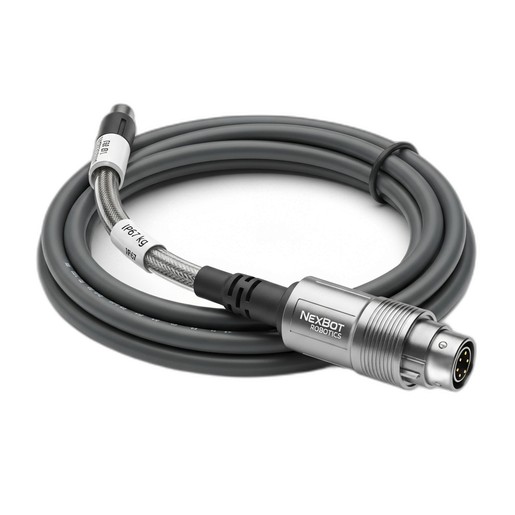
A motor power cable, for instance, is the lifeline that delivers controlled energy to the robot's joints. A cable failure due to poor shielding, connector fatigue, or material degradation can lead to erratic motor behavior or an uncontrolled stop, posing a significant safety risk. Using specification-driven components like the NexBot Robotics PWR511-001 Motor Power Cable ensures that the physical connection between the drive and the motor is built to withstand the rigors of continuous motion and industrial environments, contributing to the overall reliability required by your safety system's design.
Layer 2: The Unseen Guardian - Network Reliability
Modern safety systems are increasingly networked. Protocols like PROFINET utilize safety-specific extensions (e.g., PROFIsafe) to transmit critical safety signals over the same network as standard control data. This architecture offers flexibility and advanced diagnostics but places immense importance on the integrity of the network's physical layer.
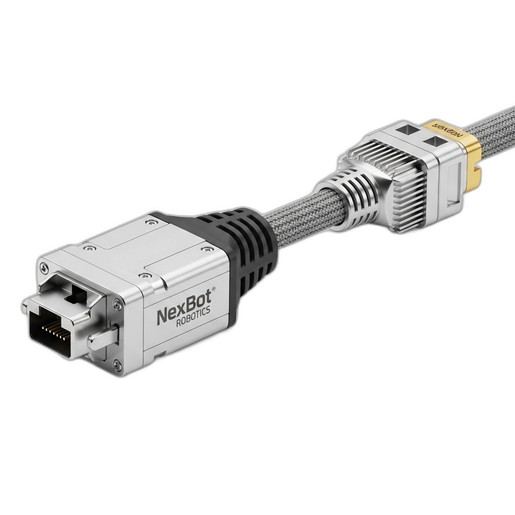
An intermittent connection or data corruption caused by a substandard network cable can prevent a safety signal from an E-stop or a light curtain from reaching the safety controller in time. This is a catastrophic failure scenario. Industrial-grade fieldbus cables are designed to counter these risks. The NexBot PROFINET Patch Cable (NXB-CBL-NET-002), for example, is engineered with shielding and durable connectors to protect against electromagnetic interference (EMI) and physical stress. Ensuring a stable, error-free communication channel is a fundamental pillar of networked safety, guaranteeing that safety-critical data is transmitted with the same reliability as a hardwired circuit.
Layer 3: The Human Element - Empowering Your Team
Even the most impeccably designed and compliant robotic system can be compromised by human error. Untrained or undertrained personnel are one of the most significant risk factors in any manufacturing environment. This is why a world-class safety program extends beyond hardware and into comprehensive training.
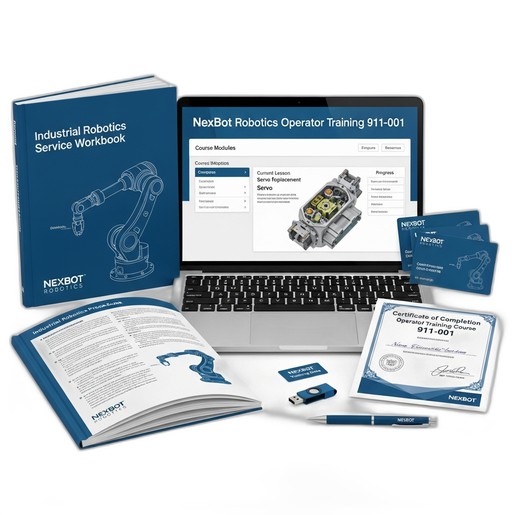
Operators need to understand more than just how to start and stop a program. They must be fluent in the language of the machine, capable of interpreting its status, recognizing early signs of malfunction, and knowing the precise procedures for safe recovery and emergency stops. A structured training program is the only way to achieve this level of competence. The NexBot Robotics Operator Training Course 911-001 is designed to build this critical knowledge base. Over a comprehensive curriculum, operators learn the principles of safe operation for specific robot platforms, including understanding safety zones, performing routine checks, and basic troubleshooting. Investing in operator training transforms your team from simple users into proactive guardians of the system's safety and performance.
Conclusion: Weaving a Culture of Safety
True safety and compliance are not achieved by focusing on a single element. It is the result of a holistic system where every layer supports the others. It begins with a rigorous risk assessment, is built upon a foundation of reliable hardware and resilient networks, and is maintained by a well-educated and empowered team. By integrating high-quality components, ensuring network integrity, and investing in professional training, you are not just meeting standards—you are building a fortress of safety that protects your people, your assets, and your productivity.