The Challenge of Robotic Perception
In the landscape of modern industrial automation, the goal has shifted from simple, repetitive tasks to complex, dynamic operations. For a robotic system to be truly autonomous and flexible, it must be able to perceive and understand its environment. While 2D vision has long been a staple for basic guidance and inspection, it falls short when dealing with depth, orientation, and unstructured settings. This is the challenge of robotic perception: enabling a machine to see in three dimensions with the accuracy and speed required for demanding industrial applications.
Tasks like bin picking—selecting randomly oriented parts from a container—or performing precise in-line quality checks on complex assemblies require a sophisticated level of spatial awareness. Without it, automation remains limited to highly controlled scenarios, requiring expensive fixtures and meticulous part presentation. True 'lights-out' manufacturing and flexible production lines depend on solving this vision challenge.
Introducing the NexBot 322-005: Precision in Three Dimensions
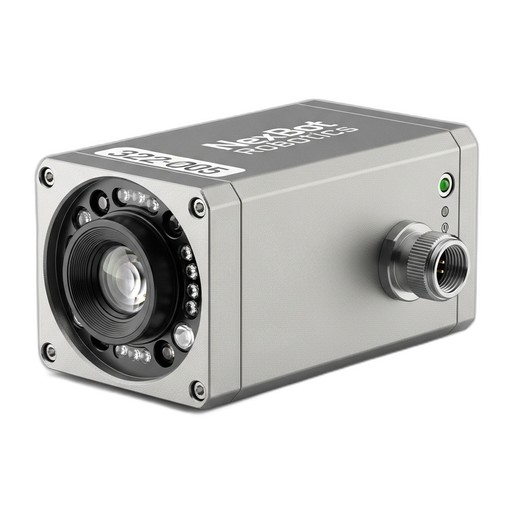
NexBot Robotics addresses this critical need with the 322-005 3D Vision Camera (NXB-SNS-322-005). This component is more than just a camera; it's a sophisticated perception system designed to provide robotic controllers with rich, accurate, and actionable spatial data. By generating detailed 3D point clouds of its field of view, the 322-005 empowers robots to navigate complex tasks with confidence and repeatability.
At its core, this vision system is engineered for the factory floor. It combines high-performance imaging with a rugged design and industry-standard communication protocols, ensuring seamless integration into new or existing automation cells. It serves as the eyes of the operation, translating the physical world into a digital format that a robot can understand and act upon.
Key Technical Specifications and Their Impact
Understanding the specifications of the NexBot 322-005 reveals why it is a powerful tool for advanced automation. Each feature is purposefully designed to overcome specific industrial challenges.
High-Resolution 2.3 MP Sensor
A 2.3-megapixel sensor captures a high level of detail, which is crucial for distinguishing between small features, identifying defects, or accurately locating the edge of a part. In bin picking applications, this high resolution allows the system's software to reliably identify viable gripping points on parts that are jumbled together or partially occluded. For inspection, it means the ability to measure geometric tolerances and detect surface imperfections that would be invisible to lower-resolution systems.
5 Hz Point Cloud Data Rate
The camera generates a complete 3D point cloud five times per second (5 Hz). A point cloud is a set of data points in 3D space that represents the external surface of an object. This 5 Hz refresh rate strikes an optimal balance between speed and data quality. It's fast enough to minimize cycle time in pick-and-place operations but ensures that each scan is dense and accurate. This allows the robot to make decisions based on up-to-date information about its workspace without being overwhelmed by an unmanageable stream of data.
Robust Gigabit Ethernet Interface
Data integrity and speed are paramount in industrial settings. The NexBot 322-005 uses a Gigabit Ethernet protocol for communication. This industry-standard interface offers high bandwidth to transmit large point cloud files quickly and reliably, even over long cable distances. GigE is also highly resistant to the electromagnetic interference (EMI) common in manufacturing environments, ensuring a stable connection between the camera and the robot controller or vision processor.
24VDC Power
By operating on 24VDC power, the camera integrates effortlessly into standard industrial control panels. This common voltage simplifies system design, eliminating the need for specialized power supplies and making installation straightforward for any qualified automation technician.
Core Applications: From Bin Picking to Quality Control
The true value of the NexBot 322-005 is demonstrated in its real-world applications.
- Automated Bin Picking: This is a classic robotics challenge where the 322-005 excels. The camera mounts above a bin of parts, captures a 3D image, and the accompanying software processes the point cloud to identify individual parts and calculate their precise 3D coordinates and orientation. This information is sent to the robot, which can then execute a successful pick, regardless of how the parts are positioned. This eliminates the need for manual sorting or complex bowl feeders, increasing efficiency and system flexibility.
- In-Line Inspection and Metrology: In quality control, the camera can be used to create a 3D digital twin of a part as it moves down the production line. This model can be compared against a master CAD file to verify critical dimensions, check for completeness (e.g., all holes drilled, all components attached), and detect surface defects like dents or warping. This enables 100% inspection at production speed, drastically reducing the risk of shipping faulty products.
Integration and Maintenance: A Holistic Approach
Deploying advanced technology successfully requires more than just capable hardware. To unlock the full potential of the 322-005 3D Vision Camera, operators and technicians must be proficient in its setup, programming, and maintenance. The NexBot Drives Training Course 911-006 (NXB-TRN-911-006) provides the essential hands-on knowledge needed to configure vision-guided robotics systems, troubleshoot common issues, and optimize performance for specific applications.
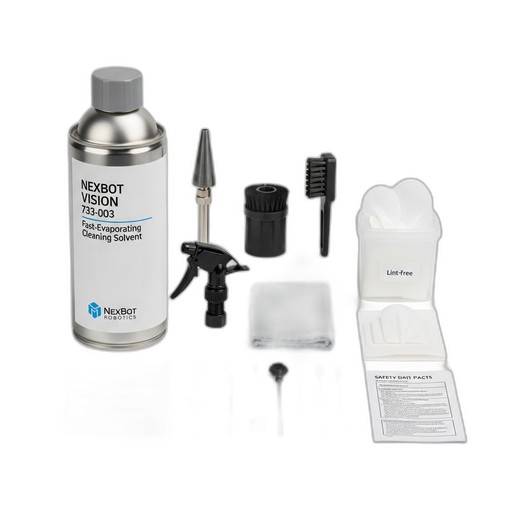
Furthermore, the long-term reliability of any vision system depends on maintaining optical clarity. Dust, oil mist, and other airborne contaminants common in industrial environments can accumulate on the camera lens, degrading image quality and compromising accuracy. Regular, proper cleaning is essential. Using a product like the NexBot Vision 733-003 Fast-Evaporating Cleaning Solvent (NXB-GEN-733-003) is highly recommended. Its specialized formula is designed to remove contaminants without leaving streaks or residue that could interfere with the sensitive optics, ensuring the camera continues to deliver precise data day after day.
Conclusion: A Clearer Vision for Your Automation Future
The NexBot Robotics 322-005 3D Vision Camera is a key enabling technology for the next generation of industrial automation. By providing robots with detailed and reliable 3D perception, it unlocks new levels of flexibility, efficiency, and quality. From streamlining complex bin picking tasks to ensuring flawless product inspection, this powerful sensor provides the data-driven insight necessary to build smarter, more capable, and more profitable manufacturing systems.