The Challenge: Overcoming Bottlenecks in Aerospace Manufacturing
AeroForge Components, a specialized manufacturer of precision parts for the aerospace industry, faced a critical challenge in their CNC machining division. Their manual machine tending and part finishing processes were creating significant production bottlenecks. Operators were tasked with repetitive loading, unloading, and deburring tasks, which not only limited cycle times but also introduced inconsistencies in final product quality. Furthermore, the aging safety infrastructure around their machinery was becoming a point of concern, leading to nuisance stops and complicating compliance with modern industrial safety standards.
The management team at AeroForge identified a clear need for automation to increase capacity, improve consistency, and enhance operator safety. They sought a solution that was robust, compliant with stringent safety regulations, and flexible enough to adapt to changing production demands without requiring a complete facility overhaul.
The Solution: A Strategic Approach to Automation and Safety
After a thorough evaluation, AeroForge's engineering team designed a new automated work cell centered around a six-axis industrial robot. To ensure the project's success, they selected key components from NexBot Robotics to build a foundation of safety, reliability, and adaptability.
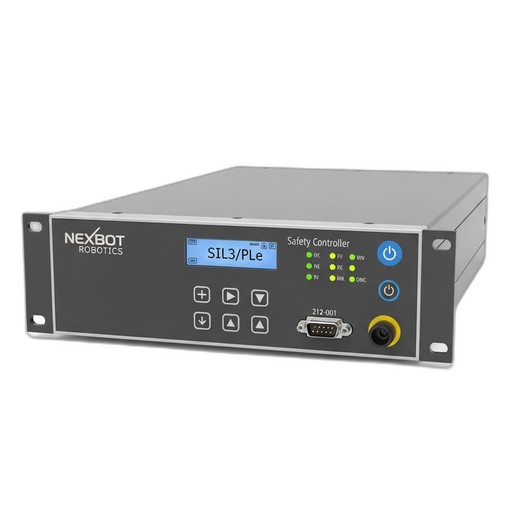
The core of the cell's safety system was the NexBot Robotics 212-001 Safety Controller (SIL3/PLe). This controller was chosen for its high safety integrity level and its ability to manage all safety functions, including emergency stops, light curtains, and gate interlocks, in a single, cohesive system. Its support for the FSoE (Fail Safe over EtherCAT) protocol streamlined integration with the primary robot controller, reducing wiring complexity and commissioning time.
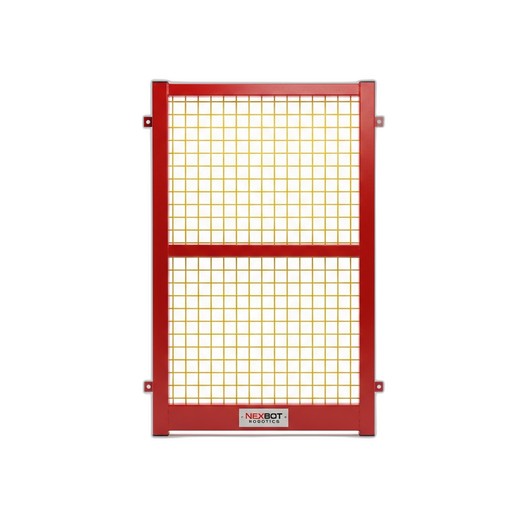
To physically secure the cell and protect personnel, AeroForge constructed a safety enclosure using NexBot Robotics 611-001 Perimeter Guard Panels. The robust steel wire mesh design provided an impenetrable barrier while maintaining full visibility of the automated process, which was crucial for monitoring and troubleshooting. The modular nature of the panels allowed for a custom layout that fit perfectly within their existing floor plan.
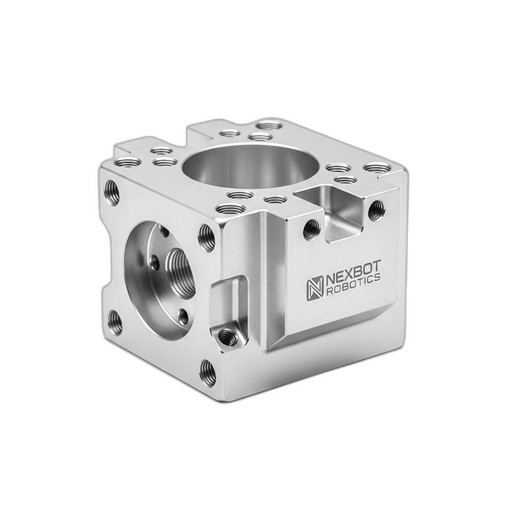
For the robot's end-of-arm tooling (EOAT), flexibility was paramount. The cell needed to handle both raw material loading (requiring a gripper) and post-machining finishing (requiring a deburring tool). The NexBot Robotics 813-001 Tool Adapter Plate provided the perfect solution. By standardizing on the ISO 9409-1-50-4-M6 pattern, the team could create a quick-change system, allowing the robot to switch between tasks with minimal downtime and ensuring precise, repeatable tool mounting.
Implementation: Building a Foundation of Safety and Flexibility
The integration process was executed by AeroForge's in-house team. The modularity of the NexBot Robotics components proved to be a significant advantage. The perimeter guard panels were assembled quickly, creating a secure zone in just one day. The safety controller was configured using intuitive software, allowing engineers to map safety inputs and outputs and define safe operational zones efficiently.
The 24VDC power requirement of the NXB-CTL-212-001 controller integrated seamlessly with their existing control cabinets. The FSoE communication layer simplified the safety network, replacing bundles of point-to-point wiring with a single industrial Ethernet cable, which drastically reduced potential points of failure and simplified diagnostics.
The tool adapter plate was mounted on the robot arm, and corresponding plates were fitted to the gripper and deburring tool. This forward-thinking approach allowed the team to calibrate both tools offline and develop robot programs that accounted for the quick-change process, maximizing the cell's operational availability from day one.
The Results: Measurable Gains in Productivity and Safety
The impact of the new automated cell was immediate and significant. AeroForge tracked several key performance indicators before and after the implementation, revealing substantial improvements:
- Throughput Increased by 25%: The robot's consistent, optimized movements reduced the average cycle time per part by 35%. This efficiency gain, combined with the ability to run the cell unattended for portions of a shift, resulted in a 25% increase in total weekly output from that specific CNC machine.
- Unscheduled Downtime Reduced by 90%: The robust, centrally managed safety system built around the NexBot Robotics 212-001 controller eliminated the frequent nuisance stops that had plagued the old system. The cell now runs with exceptional reliability.
- Ergonomic Incidents Eliminated: By automating the strenuous and repetitive manual tasks, reported incidents of ergonomic strain in that department dropped to zero. Operators were retrained for higher-value roles, such as quality control, robot programming, and cell supervision.
- Enhanced Operational Agility: The standardized tool adapter plate system proved its worth within the first quarter. When a new project required a different part geometry, the team was able to integrate a new gripper in under two hours, a task that previously would have required days of custom fabrication and testing.
Conclusion: Future-Ready with NexBot Robotics
By strategically integrating a robotic work cell with core components from NexBot Robotics, AeroForge Components successfully transformed a production bottleneck into a competitive advantage. The combination of the SIL3/PLe Safety Controller, rugged Perimeter Guard Panels, and versatile Tool Adapter Plate created a solution that not only met their immediate goals for throughput and safety but also provided a flexible, scalable platform for future growth. This case study demonstrates how a well-planned automation project, built on a foundation of reliable and compliant components, can deliver a powerful return on investment for modern manufacturers.