Industrial robots are paragons of precision and speed. Whether it's a SCARA robot executing a rapid pick-and-place cycle or a 6-axis arm performing a complex welding path, their ability to repeat a motion flawlessly thousands of times is the bedrock of modern automation. But this capability isn't magic; it's the result of a sophisticated, multi-layered system known as motion control.
In this technology deep dive, we will dissect the anatomy of a robot's movement, exploring the synthesis of software, electronics, and mechanics that enables such remarkable performance. Understanding these principles is key to selecting, integrating, and maintaining the right robotic solution for your application.
The Core Components of a Motion Control System
At its heart, a motion control system is a closed-loop feedback mechanism. It calculates a desired path, sends commands to move the robot, measures the actual movement, and continuously corrects for any deviation. This loop consists of several critical components:
- The Robot Controller: This is the brain of the operation. It houses the central processor that runs the robot's operating system and user-programmed logic. The controller is responsible for the most computationally intensive tasks, including solving kinematic equations and planning trajectories. It communicates with the rest of the system via a high-speed industrial network protocol. For many modern systems, including NexBot robots, protocols like PROFINET are used to ensure deterministic, real-time data exchange, which is essential for synchronized, multi-axis motion.
- Drives (Amplifiers): If the controller is the brain, the drives are the muscular system. They receive low-voltage control signals from the controller and amplify them into high-power current and voltage to energize the robot's motors. Modern digital servo drives do more than just amplify; they also close the torque and velocity loops locally, executing commands from the controller with high fidelity.
- Motors (Actuators): These are the joints of the robot, converting electrical energy into mechanical rotation. Industrial robots almost exclusively use high-performance AC servo motors, which provide exceptional torque, speed, and positional accuracy.
- Feedback Devices (Encoders): These are the robot's sense of proprioception. High-resolution encoders are mounted on each motor shaft, constantly reporting the precise angular position and velocity of each joint back to the controller. This feedback closes the position loop, allowing the controller to instantly detect and correct any error between the commanded position and the actual position.
Kinematics: The Mathematics of Movement
Kinematics is the branch of mechanics that describes the motion of objects without considering the forces that cause it. For a robot, it's the mathematical framework that relates the angles of its individual joints to the position and orientation of its end-effector (the tool or gripper).
- Forward Kinematics: This is the relatively simple process of calculating the end-effector's position in 3D space given the known angles of each of the robot's joints. It's a straightforward set of geometric equations.
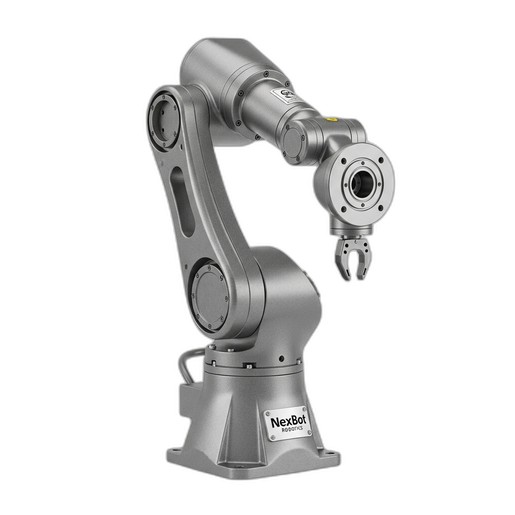
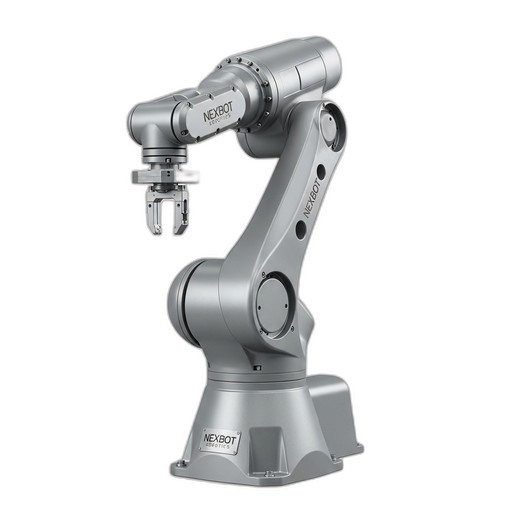
- Inverse Kinematics (IK): This is the far more complex and critical challenge. IK involves calculating the necessary joint angles required to place the end-effector at a specific target position and orientation. The complexity of these calculations scales with the robot's degrees of freedom. For a 4-axis robot like the NexBot Robotics STD031-005 SCARA, which operates primarily on a 2D plane with vertical motion, the IK is relatively simple, contributing to its renowned speed. For a 6-axis articulated arm like the NexBot Drives SA011-006, the IK is significantly more demanding, as there are often multiple joint configurations that can achieve the same tool-point position. The robot controller must solve these complex equations in real-time to generate smooth, predictable paths.
Trajectory Planning: From Point A to Point B
Once the controller knows how to position the arm (via kinematics), it must plan the path, or trajectory, between points. This isn't as simple as just moving each joint at full speed. A well-planned trajectory ensures efficiency, safety, and smoothness.
- Point-to-Point (PTP) Motion: The robot moves from a start point to an end point, where the exact path taken between them is not critical. The controller optimizes the movement of each joint to get to the destination as quickly as possible.
- Continuous Path (CP) Motion: The robot's tool must follow a precisely defined path, such as a straight line (Linear) or an arc (Circular). This is essential for applications like dispensing, welding, or machining. The controller must perform complex interpolation, coordinating all axes to maintain the specified path and tool orientation at a constant velocity.
To avoid mechanical stress and vibration, controllers use velocity profiling, often in an "S-curve" shape. This gently accelerates the arm, holds a constant speed, and then gently decelerates, minimizing jerk and ensuring smooth handling of the payload.
The Mechanical Foundation: Precision is Physical
Sophisticated algorithms and powerful processors are meaningless without a robust mechanical structure to execute their commands. The physical integrity of the robot arm is the final, and perhaps most important, piece of the motion control puzzle. Factors like gear backlash, belt tension, and component stiffness directly impact the robot's real-world accuracy and repeatability.
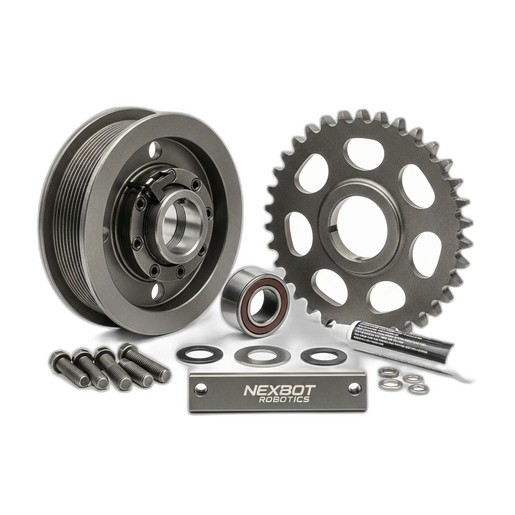
This is why the quality of individual components is paramount. For instance, the power from a motor is transmitted to a joint through a series of gears, belts, and pulleys. Any imprecision or wear in these components introduces error into the system. A component like the NexBot Vision 722-003 Hardened Steel Pulley and Sprocket Set is engineered to address this. Machined from high-wear-resistance materials to tight tolerances, it ensures that the rotational motion of the motor is transferred precisely and without slop, or backlash. This mechanical fidelity ensures that the controller's precise digital commands are translated into equally precise physical motion, cycle after cycle.
Conclusion
Robot motion control is a masterful integration of digital intelligence and mechanical reality. From the high-level task programming down to the material science of a single sprocket, every layer contributes to the final performance. By understanding the interplay between controllers, kinematics, trajectory planning, and high-integrity mechanical components, we can better appreciate the technology that drives modern manufacturing and select the optimal robotic systems—be it a high-speed SCARA or a versatile 6-axis arm—to meet the challenges of any automation task.