The Challenge: Precision Bottlenecks in Electronics Assembly
Aperture Components, a mid-sized manufacturer of high-density connectors for the telecommunications industry, faced a critical growth obstacle. Their primary assembly line relied on skilled technicians manually orienting and inserting delicate multi-pin connectors into circuit boards. This process was not only slow and tedious but also a major source of production inconsistencies.
The challenges were threefold:
- Throughput Limitations: Manual handling and alignment capped production at approximately 200 units per hour, creating a bottleneck that limited their ability to fulfill larger orders.
- Quality Control Issues: The microscopic scale of the components led to a defect rate of nearly 4%, primarily from bent pins or incorrect seating. These errors were costly, often requiring the entire board to be scrapped.
- Ergonomic Strain: The repetitive, high-precision nature of the task led to operator fatigue and an increased risk of repetitive strain injuries, impacting team morale and retention.
Aperture Components knew that to scale their operations and maintain their reputation for quality, they needed to embrace automation.
The Solution: A NexBot Integrated Automation Cell
After a thorough evaluation, Aperture Components partnered with NexBot Robotics to design and implement a custom, vision-guided robotic assembly cell. The solution was engineered to directly address their specific challenges, integrating several key NexBot products and services to create a seamless, high-performance system.
The core of the new cell is a high-speed 6-axis robot integrated with a NexBot vision system. This setup automates the entire pick, orient, and place process, transforming the assembly line from a manual bottleneck into a model of efficiency.
Key Components of Success
The project's remarkable success hinged on the strategic integration of robust components and the empowerment of Aperture's engineering team through specialized training.
Consistent Part Handling with the 841-009 Vibratory Feeder
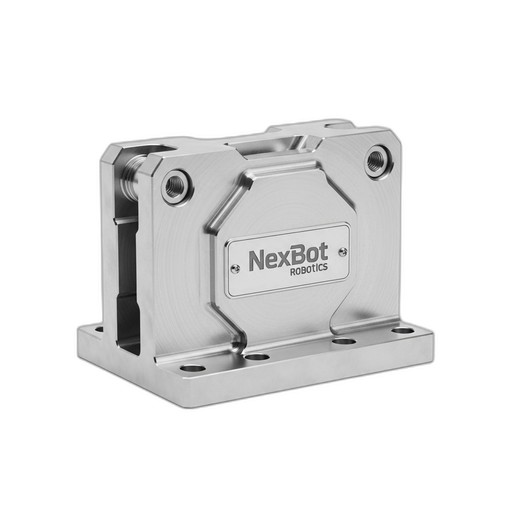
The first step in any successful pick-and-place operation is presenting parts to the robot in a consistent and predictable manner. The NexBot Robotics 841-009 Vibratory Parts Feeder was the perfect solution. Its 400mm stainless steel bowl was custom-tooled to handle Aperture's unique connector geometry. Using gentle vibrations, the feeder efficiently orients and funnels the connectors into a single file line, ready for robotic pickup. This eliminated the variability and time consumption of manual part handling, providing a steady, reliable stream of components to the robot and laying the foundation for high-speed assembly.
Reliable Control and Quality Sensing with the 242-008 Analog I/O Module
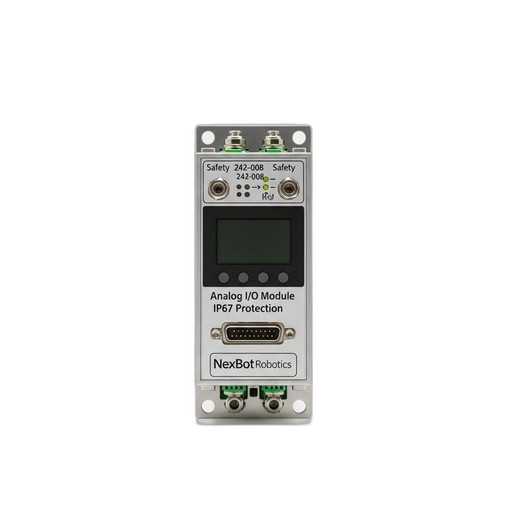
To ensure each connector was inserted correctly, the robotic cell was equipped with a force-torque sensor on the end-effector. This is where the NexBot Safety 242-008 Analog I/O Module played a critical role. This robust 24VDC module, communicating via the IO-Link protocol, served as the nerve center for processing the analog data from the sensor.
During insertion, the module translated the subtle force feedback into actionable data for the robot controller. If the force exceeded a pre-defined threshold, indicating a misaligned pin or obstruction, the system would instantly flag the part, discard it, and log the error without stopping the line. This real-time quality assurance, enabled by the 242-008 module, was instrumental in slashing the defect rate.
Empowering the Team with Advanced Vision Training
Hardware alone is only part of the solution. Aperture Components wanted to own their automation long-term, reducing reliance on external integrators for system adjustments and troubleshooting. To achieve this, two of their lead engineers enrolled in the NexBot Vision Advanced Programming Training Course 913-015.
This intensive, 3-day hands-on course equipped their team with the skills to master the vision-guided system. They learned advanced calibration techniques, part recognition programming, and sophisticated troubleshooting methodologies. This investment in training proved invaluable, allowing Aperture's team to confidently fine-tune the system for new connector types and perform routine maintenance, ensuring maximum uptime and adaptability.
The Results: Measurable Gains in Productivity and Quality
The transition to the NexBot automated cell delivered transformative results within the first six months of operation:
- Throughput Increased by 150%: The automated cell now consistently assembles over 500 units per hour, shattering the previous manual production ceiling.
- Defect Rate Reduced by 95%: The combination of vision guidance and force-feedback sensing dropped the defect rate from 4% to less than 0.2%.
- Projected ROI in 18 Months: The significant gains in productivity and quality, coupled with reduced labor costs and material waste, put the project on track for a full return on investment in just 18 months.
- Improved Employee Focus: Technicians previously tasked with manual assembly were retrained for higher-value roles, including quality oversight and robotic cell supervision, improving job satisfaction and overall plant safety.
Conclusion: A Partnership for Future Growth
The collaboration between Aperture Components and NexBot Robotics demonstrates the power of a holistic approach to automation. By combining reliable hardware like the 841-009 Parts Feeder and 242-008 I/O Module with essential services like the Advanced Vision Training Course, Aperture Components didn't just buy a robot; they invested in a scalable, in-house capability. This successful project has become a blueprint for their company-wide Industry 4.0 initiative, positioning them for sustained growth and a competitive edge in the demanding electronics market.