In any automated facility, the silence of an idle production line is deafening. Unplanned downtime doesn't just halt output; it creates a cascade of costs from lost revenue and missed deadlines to overtime pay for technicians scrambling to make repairs. The most effective strategy to combat this is not a faster repair, but preventing the failure in the first place. This is the core principle of a robust Preventive Maintenance (PM) program for your industrial robots.
A proactive approach shifts your maintenance mindset from reactive crisis management to scheduled, controlled servicing. By addressing wear and tear before it leads to failure, you can maximize your robot's operational lifespan, ensure consistent performance, and maintain a safer work environment.
The Pillars of a Solid Robot Maintenance Plan
A successful PM program is built on three fundamental pillars: regular inspections, scheduled servicing, and comprehensive training. Each plays a distinct but interconnected role in ensuring your automation investment delivers its full potential.
- Regular Inspections (Daily/Weekly): These are the first line of defense. Operators should perform visual and auditory checks at the start of each shift. This includes looking for fluid leaks, frayed cables, unusual vibrations, or abnormal noises. Early detection of these symptoms can prevent a minor issue from escalating into a major breakdown.
- Scheduled Servicing (Interval-Based): This is the heart of your PM plan. Based on manufacturer recommendations and operational hours, specific components are replaced and serviced at set intervals. This includes tasks like re-greasing joints, replacing batteries, and changing filters. Using standardized kits ensures you have all the necessary, correct parts on hand.
- Comprehensive Training: A well-designed plan is only as effective as the team executing it. Technicians need the skills to perform maintenance correctly and safely, while operators need to be trained to recognize the early warning signs of a potential problem.
Key Maintenance Tasks: A Checklist for Success
While every robot model has its unique requirements, a universal set of maintenance tasks applies to most industrial robotic arms. These tasks are typically scheduled based on operational hours, with common intervals at 1,000, 4,000, and 12,000 hours.
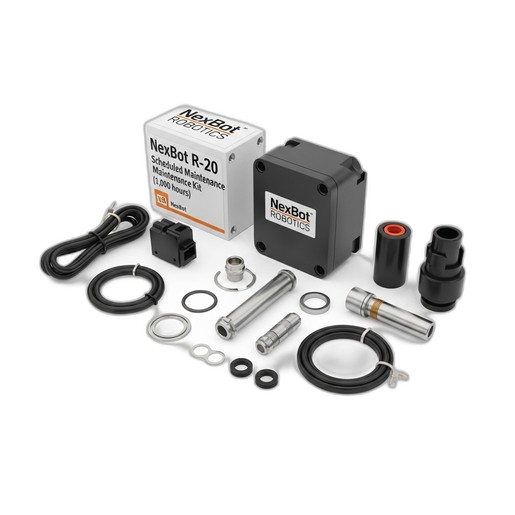
Let's focus on a typical 1,000-hour service, often covered by kits like the NexBot R-20 Scheduled Maintenance Kit (NXB-KIT-R20-1000).
- Grease and Lubrication: Proper lubrication is critical for reducing friction and wear on gears and bearings. It's essential to not only apply grease at the correct interval but also to use the specific type recommended for your robot. Using the wrong grease can be as damaging as using no grease at all. The grease cartridge in a maintenance kit eliminates this guesswork.
- Seals & O-Rings: These components are vital for protecting the sensitive internal mechanics of the robot's joints from contaminants like dust, metal shavings, and moisture. Over time, they can degrade and lose their effectiveness. Replacing them during a scheduled service is a low-cost, high-impact preventive measure.
- Encoder Battery Replacement: The robot's encoders are responsible for tracking the exact position of each axis. They are powered by a small battery that ensures this position data is retained even when the main power is off. If this battery fails, the robot loses its 'home' position, leading to a lengthy and complex re-mastering process. Proactively replacing the encoder battery is one of the most important PM tasks.
- Filter Set Inspection and Replacement: Many robots use fans and filters to cool critical electronics in the controller and the arm itself. Clogged filters can lead to overheating, causing component failure and erratic robot behavior. Regular replacement ensures optimal thermal management.
The Critical Role of Training in Maintenance Excellence
Having the right parts is only half the battle. Your team's knowledge and skills are the force multipliers that turn a good maintenance plan into a great one. This is where targeted training becomes indispensable.
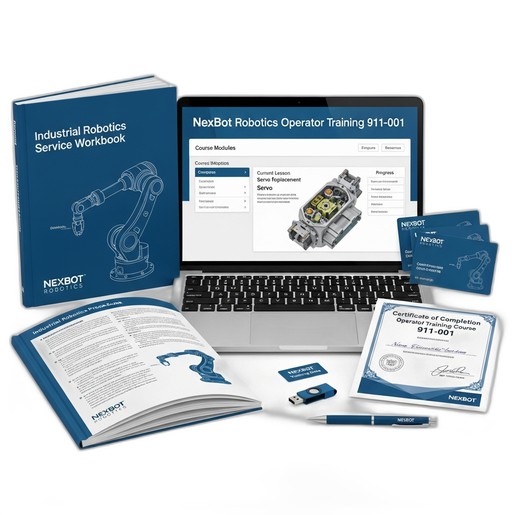
Operator-level training, such as the NexBot Robotics Operator Training Course (NXB-TRN-911-001), empowers the people who interact with the robot every day. A well-trained operator is not just a user; they are a frontline sensor. They can identify subtle changes in the robot's movement or sound that might indicate a developing issue, allowing maintenance to be scheduled before a failure occurs. This course provides the foundational knowledge of safe operation and basic troubleshooting that underpins a proactive maintenance culture.
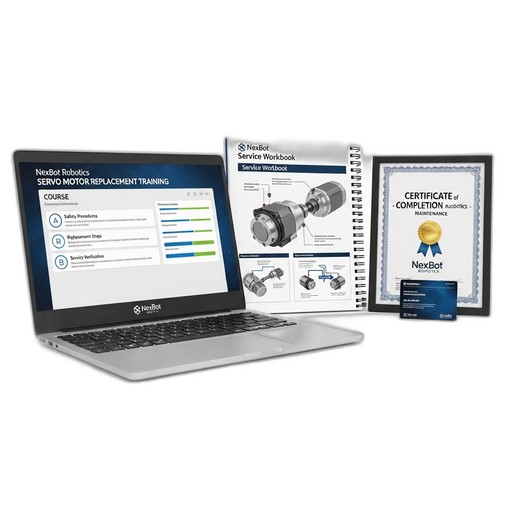
For more complex tasks, specialized maintenance training is crucial. A procedure like a servo motor replacement, for example, requires a deep understanding of mechanical and electrical systems, as well as specific diagnostic workflows. The Servo Motor Replacement Online Training (NXB-TRN-SRV-ONL) is designed to build this expertise. It gives technicians the confidence to perform complex repairs efficiently and correctly, following standardized procedures that minimize the risk of errors and ensure the robot is returned to service in optimal condition.
Standardize and Simplify with Maintenance Kits
To ensure consistency and efficiency, standardizing your service intervals with pre-packaged maintenance kits is a best practice. A kit like the NexBot R-20 Scheduled Maintenance Kit (NXB-KIT-R20-1000) provides several key advantages:
- Reduces Errors: All necessary components are in one box, eliminating the risk of ordering the wrong part number.
- Saves Time: Technicians don't have to waste time sourcing individual seals, batteries, and filters.
- Ensures Quality: You receive genuine, factory-spec parts designed to work perfectly with your equipment.
- Simplifies Inventory: Instead of managing dozens of SKUs for small parts, you only need to stock a few kit numbers.
By building a maintenance strategy around scheduled intervals, certified kits, and continuous training, you transform maintenance from an unpredictable expense into a strategic investment in uptime and reliability. Your robots will run longer, perform better, and contribute more effectively to your bottom line.