The landscape of industrial automation is undergoing a profound transformation. For decades, the image of a robot was a large, caged arm performing a single, repetitive task with brute force and precision. While that image still holds true in many applications, it no longer captures the full picture. Today, the industry is driven by the principles of Industry 4.0—connectivity, data, and intelligence. This evolution isn't just about the robot arm itself; it's about the ecosystem of technologies that empower it to be more flexible, intuitive, and effective than ever before. Let's explore the key trends that are shaping this new era of robotics, from the way we interact with them to the very foundation of their mechanical design.
The Democratization of Robot Programming
One of the most significant barriers to wider automation adoption has historically been the complexity of robot programming. Traditionally, programming a robot required specialized knowledge of proprietary coding languages, making it a task reserved for highly trained engineers. This created a skills gap and increased the total cost of implementation. The current trend is a powerful shift towards democratization, making robot control accessible to a broader range of personnel, including machine operators and maintenance technicians.
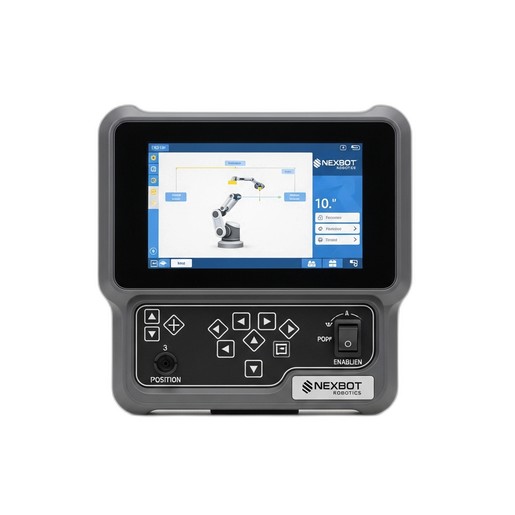
This shift is enabled by advancements in Human-Machine Interfaces (HMI). Modern teach pendants are moving away from cryptic text-based interfaces to intuitive, graphical, and touch-based systems. Devices like the NexBot Drives 221-018 Teach Pendant exemplify this trend. With a responsive 10.1-inch color touchscreen, operators can use familiar drag-and-drop logic, visual waypoint setting, and guided workflows to program complex tasks. This not only drastically reduces training time but also empowers shop-floor staff to make minor adjustments and troubleshoot issues without calling in an engineer. The inclusion of robust safety features, such as a 3-position enabling switch, and a durable IP65-rated housing ensures that this user-friendliness doesn't come at the expense of safety or reliability in harsh industrial environments.
The Rise of Intelligent Vision Systems
As manufacturing demands greater flexibility and higher quality control, robots need to do more than just follow a pre-programmed path—they need to see, interpret, and adapt to their environment. This is where machine vision comes in. The integration of advanced vision systems is a cornerstone of Industry 4.0, enabling applications like bin-picking, adaptive assembly, and real-time quality inspection.
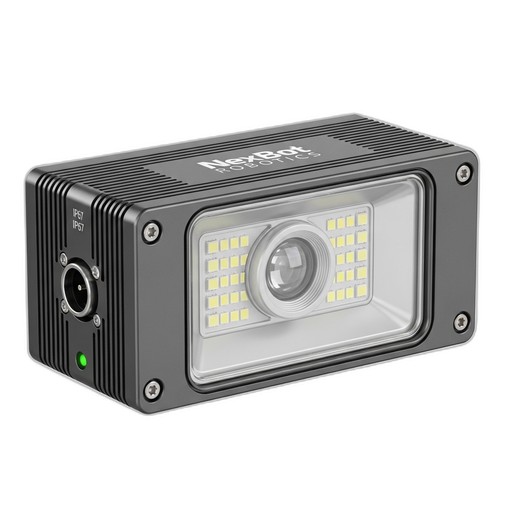
A successful vision system, however, is more than just a high-resolution camera. The quality and consistency of the lighting are arguably the most critical factors for reliable performance. Inconsistent or poor lighting can lead to misidentification of parts, inaccurate measurements, and costly production errors. The trend is towards integrated, high-intensity lighting solutions that provide uniform illumination, eliminating shadows and reflections that can confuse vision algorithms. The NexBot Vision 323-015 Vision Lighting Module is a prime example of a component designed to meet this need. By delivering 12,000 lumens of bright, 6000K daylight illumination, it creates a controlled environment where the vision system can capture clear, high-contrast images every time. Furthermore, its integration with protocols like IO-Link allows for smart control, enabling dynamic adjustments to intensity and diagnostics, making the entire vision system more robust and data-driven.
Precision as the Bedrock of High Performance
While software, AI, and advanced sensors often steal the spotlight, a fundamental trend that underpins all robotic advancement is an unwavering focus on mechanical precision. A robot is a physical system, and its ability to perform tasks with high repeatability is directly tied to the quality and integrity of its mechanical construction. As robots become faster and are tasked with more delicate and precise operations, the importance of foundational components cannot be overstated.
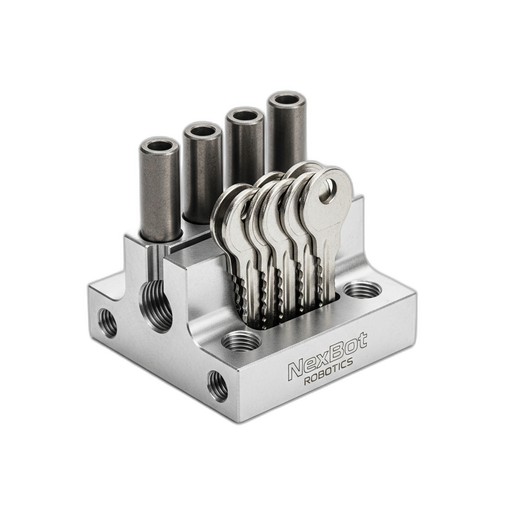
Every joint, actuator, and structural element must work in perfect harmony. This is where seemingly simple components play a mission-critical role. For instance, the secure alignment of a motor to a gearbox or the precise positioning of a joint axis is essential for eliminating backlash and ensuring that the robot's end-effector is exactly where the controller commands it to be. The NexBot Drives 832-006 Dowel Pin And Key Set represents this foundational layer of precision. Made from precision-ground hardened steel, these components ensure a zero-slip, perfectly aligned connection for transmitting torque and maintaining structural rigidity. Without this level of mechanical integrity, even the most advanced control algorithms and vision systems would be ineffective, as the robot's physical movements would be unpredictable. This trend highlights that in the world of high-tech automation, excellence is built from the ground up, starting with the highest quality hardware.
The Convergence of Technologies
These trends are not happening in isolation. The future of industrial robotics lies in their convergence. An operator using an intuitive teach pendant to set up a vision-guided inspection task is leveraging both user-friendly HMI and advanced sensing. The success of that task, in turn, depends on the robot's ability to repeatedly move to the correct position with micron-level accuracy, a feat made possible by its precise mechanical construction. This synergy—between accessible interfaces, intelligent sensing, and mechanical robustness—is what allows modern robotic systems to be so versatile. It’s what enables a single robotic cell to be quickly re-tasked for a new product line, inspect parts with a level of detail that surpasses human capability, and operate reliably for tens of thousands of hours. As we move forward, the companies that succeed will be those that understand and invest in this complete ecosystem, recognizing that the most advanced robot is only as strong as its weakest link.