Introduction: The Unseen Pillars of Automation
When we envision an industrial robotics system, our focus is naturally drawn to the articulated arm—a marvel of engineering executing complex tasks with breathtaking speed and precision. We celebrate the advanced motion control algorithms, the sophisticated end-of-arm tooling, and the intelligent vision systems. Yet, the long-term success of any automated cell hinges not just on the robot itself, but on the foundational technologies that support, protect, and maintain it. These are the unseen pillars: the mounting systems that guarantee stability, the safety components that protect personnel, and the consumables that ensure mechanical integrity over millions of cycles.
In this technology deep dive, we will look beyond the arm to explore the critical engineering that underpins a safe, reliable, and productive robotic cell. We'll examine how seemingly simple components are, in fact, integral to complying with rigorous safety standards and achieving maximum operational uptime.
The Bedrock of Safety: Secure Mounting and Positioning
Before a single line of code is executed, a robot's relationship with its environment is physically defined. This begins at the floor. The kinetic forces generated by a high-speed industrial robot are immense. Any instability at its base is magnified at the end effector, leading to inaccuracies, excessive vibration, and premature wear. More critically, an improperly secured robot is a significant safety hazard.
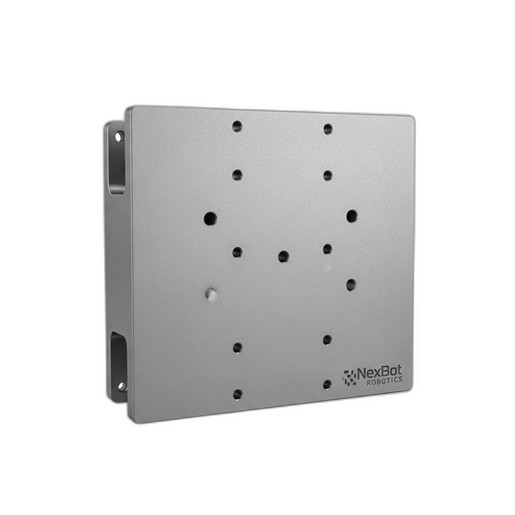
This is where components like the NexBot Robotics 641-017 Robot Floor Mounting Plate become indispensable. A high-quality mounting plate is engineered to do more than just hold a robot down. It provides a perfectly flat, rigid interface that dampens vibration and ensures the robot's base is true to the factory floor. This precision is the first step in a chain of positional accuracy that is crucial for tasks like welding, assembly, and material handling. Specification-driven design ensures that the plate matches the robot's footprint and load requirements, forming a stable foundation that is the starting point for any valid risk assessment.
With the robot securely in place, the next layer of technology addresses personnel safety. Modern robotic cells often rely on presence-sensing safety devices, such as light curtains, to create a protective field. These devices stop the robot when an operator enters a hazardous area. However, their effectiveness is entirely dependent on their placement and orientation. According to safety standards like ISO 13849, the positioning of safety devices must be calculated based on the robot's maximum speed and stopping time to ensure it can halt all motion before a person can reach the hazard.
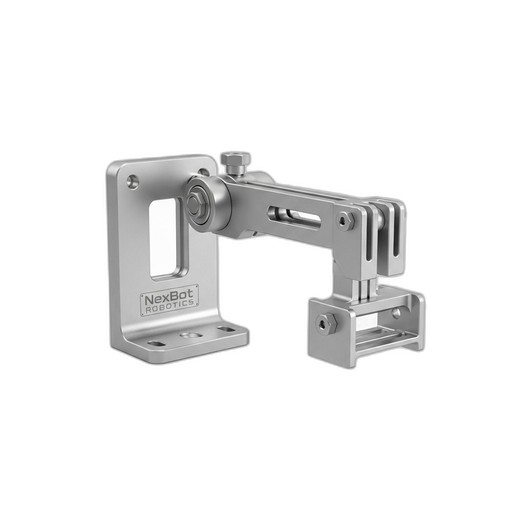
Achieving this precise positioning requires robust and flexible mounting hardware. The NexBot Robotics 612-017 Adjustable Light Curtain Mount Set is engineered for this exact purpose. Its durable aluminum construction resists vibration and industrial contaminants, while its 180° of rotational adjustment allows technicians to align the light curtain beams perfectly. This adjustability is not a matter of convenience; it is a technical requirement for creating a compliant and effective safety zone that doesn't create unnecessary operational interruptions.
The Science of Motion: Performance and Longevity
While static components provide the foundation for safety, the dynamic performance and longevity of the robot depend on the science of tribology—the study of friction, wear, and lubrication. Each joint in a robotic arm contains a complex system of gears, bearings, and servomotors working in concert. The immense torque and rapid acceleration subject these components to extreme mechanical stress and heat.
Without proper lubrication, friction would quickly lead to catastrophic failure. The grease within these joints is not a simple lubricant; it is a highly engineered fluid. It must maintain a stable viscosity across a wide range of operating temperatures, resist being squeezed out under high pressure (shear stability), and contain additives that prevent corrosion and microscopic wear. The formulation of this grease is as critical to the robot's performance as the design of its gearbox.
This is why a systematic approach to re-lubrication is a cornerstone of any preventive maintenance program. Using a product like the NexBot Drives 731-006 Joint Grease Cartridge ensures that the correct formulation, as specified by the manufacturer, is applied. Using a generic or incorrect grease can alter the robot's performance, increase energy consumption, and drastically shorten the life of its most expensive components. The service-ready cartridge design facilitates clean, accurate installation, preventing contamination and ensuring the correct volume is dispensed. This specification-driven approach to maintenance transforms lubrication from a routine task into a strategic measure to protect the investment and guarantee consistent performance.
An Integrated System: Tying It All Together
It is a mistake to view these foundational technologies in isolation. A robotic cell is an integrated system where the failure of one component can cascade and compromise the entire operation. Consider the connections:
- Stability and Maintenance: A robot secured with a proper floor mount experiences less vibration, which in turn reduces the rate of wear on its internal gears and bearings, extending the effective life of its joint grease.
- Maintenance and Safety: A poorly lubricated joint can lead to jerky, unpredictable movements or a longer-than-expected stopping time. This can invalidate the safety calculations used to position the light curtains, putting personnel at risk.
- Safety and Uptime: A well-designed safety system with properly positioned light curtains prevents accidents without causing nuisance trips that interrupt production. This is only possible with stable, adjustable mounts.
Ultimately, the pursuit of Industry 4.0 and smart manufacturing relies on the data-driven optimization of highly reliable systems. That reliability is not born in the cloud; it is built from the ground up on a foundation of superior mechanical and safety engineering. Investing in high-quality mounting hardware, safety components, and maintenance consumables is a direct investment in the core tenets of modern automation: safety, uptime, and long-term profitability.