As industrial automation evolves, so too must our approach to safety. The era of simply enclosing every robot in a heavy-duty cage is giving way to more dynamic, intelligent, and collaborative safety systems. Achieving a safe and compliant robotic workcell isn't about a single solution; it's about a multi-layered strategy that begins long before the robot is powered on and extends to the smallest components in the system. This holistic approach not only protects personnel but also enhances productivity by minimizing unnecessary downtime and enabling more flexible workflows. Understanding standards like ISO 13849 is crucial, but implementing them effectively requires a deep dive into planning, active protection, and system reliability.
The Foundation: Proactive Safety Through Simulation
The most effective way to mitigate risk is to identify and design it out of the system from the very beginning. This is where virtual design and simulation become indispensable tools for modern safety engineering. Before a single piece of hardware is ordered or a foundation is poured, a comprehensive risk assessment must be performed. This process involves identifying all potential hazards, from robot motion paths and tooling to potential human interaction points.
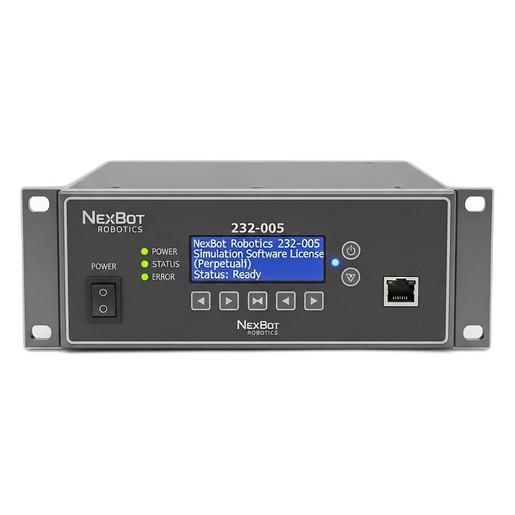
Traditionally, this was a challenging, often theoretical exercise. Today, powerful tools like the NexBot Robotics 232-005 Simulation Software allow engineers and safety professionals to build and test a complete digital twin of the robotic workcell. Within this virtual environment, you can:
- Validate Layouts: Test different equipment placements to ensure safe clearances and ergonomic access for maintenance tasks.
- Simulate Failure Modes: Analyze what happens during unexpected events, like a dropped part or a power outage, without any real-world consequences.
- Optimize Safety Zones: Precisely define the placement of safety devices like light curtains or area scanners and validate their coverage and response times.
- Verify Reach and Motion: Ensure the robot's programmed path never creates a crushing or pinning hazard against fixed structures.
By using simulation, you transition from a reactive to a proactive safety posture. Problems are solved on a screen, not on the shop floor, dramatically reducing commissioning time, avoiding costly physical rework, and providing documented proof of due diligence for your risk assessment process.
The First Line of Defense: Active Personnel Protection
Once the workcell design is optimized, the next layer is active guarding. While fixed barriers still have their place, modern automation often requires more flexible access for operators, material handling, or maintenance. This is the domain of presence-sensing safety devices, which create intangible but highly effective protective fields.
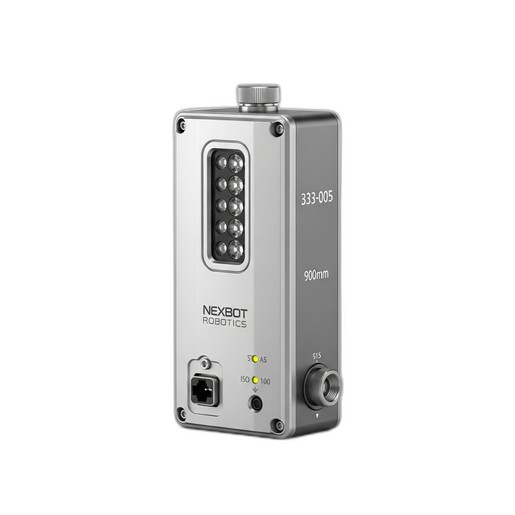
The NexBot Robotics 333-005 Safety Light Curtain is a prime example of this technology. As a Type 4 safety device, it is designed for high-risk applications where an accident could result in serious injury. Its 14mm beam resolution provides reliable finger protection, ensuring that even the smallest intrusion into the protected area is detected. When a beam is broken, the light curtain sends an instantaneous stop signal to the machine's safety control system, bringing hazardous motion to a halt far faster than a human operator could react.
Implementing a light curtain involves more than just mounting it. Key considerations include:
- Safety Distance: The curtain must be placed at a specific distance from the hazard, calculated based on the overall system stopping time and the approach speed of personnel. This ensures that the machine can stop completely before a person can reach the danger zone.
- Protected Height: With a 900mm protected height, the NXB-GEN-333-005 is suitable for safeguarding significant access points, preventing operators from reaching over or under the protective field.
- Integration: The device must be wired into a safety-rated control circuit. Its 24VDC operation and IO-Link protocol simplify integration and provide valuable diagnostic data, but the overall safety function must be designed and validated to meet the required Performance Level (PL) as determined by your ISO 13849 risk assessment.
The Unseen Guardian: Ensuring System Reliability
A safety system is only as strong as its weakest link. While simulation software and light curtains are visible pillars of safety, the underlying integrity of the entire control system is equally critical. A robot's ability to operate safely depends on its ability to know its exact position and execute motion commands with perfect fidelity. This is where high-quality components play a vital, if often overlooked, role.
Consider the pathway for motion control data. A central controller sends a command, and an encoder on a motor reports back its exact position and velocity. This feedback loop happens thousands of times per second. The physical link for this critical data is an encoder cable. A failure or degradation of this signal could lead to unpredictable robot behavior, creating a severe safety hazard.
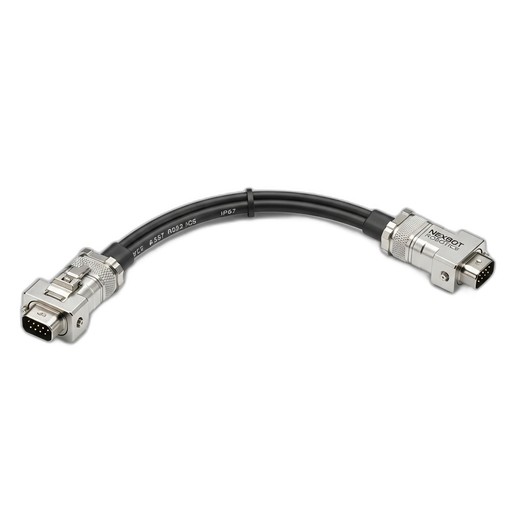
Using a robust, properly specified cable like the NexBot Robotics ENC521-005 Encoder Cable is a fundamental aspect of building a reliable and safe system. Industrial environments are harsh, with potential exposure to electrical noise, vibration, and physical stress. A specification-driven cable designed for industrial robotics ensures:
- Signal Integrity: Proper shielding and construction protect the sensitive encoder signals from electromagnetic interference (EMI), preventing data corruption that could lead to erratic motion.
- Durability: Built to withstand the constant flexing and environmental demands of a robotic application, reducing the risk of intermittent connections or outright failure.
- Predictable Performance: Adhering to standards like PROFINET ensures seamless communication within the control architecture, contributing to the overall reliability calculations required by safety standards.
Choosing a high-quality encoder cable isn't just a maintenance decision; it's a safety design decision that underpins the predictability and stability of the entire robotic system.
Conclusion: A Unified Strategy for Safety and Productivity
Achieving safety and compliance in an industrial robotics setting is a comprehensive process. It starts with virtual planning and risk assessment using powerful simulation software. It's enforced by active, intelligent guarding devices like safety light curtains. And it's sustained by a foundation of reliable, high-integrity components that ensure the system operates as designed, every single cycle. By embracing this layered approach, you can build robotic systems that are not only compliant with rigorous standards but are also more flexible, reliable, and productive.