Introduction: The Unsung Hero of Robotic Flexibility
In the world of industrial automation, the robotic arm often captures the spotlight with its impressive speed and precision. However, the true productivity of a robotic cell is frequently determined by what happens at its wrist: the End-of-Arm Tooling (EOAT). For operations requiring multiple tasks—such as gripping, welding, deburring, and inspection—the ability to switch tools efficiently and reliably is paramount. This is the domain of the robotic tool changer, a critical component that acts as a force multiplier for automation.
But a tool changer is far more than a simple mechanical adapter. Its failure can lead to catastrophic damage to the robot, the workpiece, and surrounding equipment. Ensuring its operational integrity involves a sophisticated interplay of robust mechanical engineering, precise sensor technology, and seamless communication protocols that integrate directly into the robot's safety system. This deep dive explores the technology that makes modern tool changers the reliable and safe linchpins of flexible automation.
The Foundation: Mechanical Integrity and Locking Mechanisms
The primary function of any tool changer is to provide a rigid, zero-backlash connection between the robot arm and the tool. This connection must guarantee high repeatability, ensuring the tool returns to the exact same position and orientation every time it's coupled. The core of this function lies in the locking mechanism.
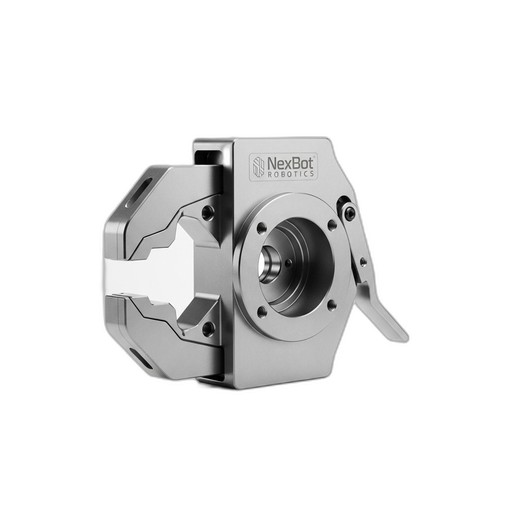
These mechanisms are marvels of mechanical engineering, often employing systems like hardened steel locking balls, tapered pins, or cam-driven pistons to create an incredibly strong bond. For applications with less frequent changeovers or in environments where manual intervention is practical, manual tool changers provide a simple and robust solution. The NexBot Vision 422-011 Manual Tool Changer, for instance, uses a secure lever-actuated lock designed to handle significant forces, supporting payloads up to 100 kg. The design provides clear tactile and visual feedback to the operator, confirming that the tool is securely locked in place before the robot is re-engaged. This positive mechanical engagement is the first and most fundamental layer of safety.
The Digital Handshake: Sensors and Communication in Automatic Changers
As production demands increase, the need for fully autonomous tool changes becomes essential. In an automatic system, there is no human operator to verify a successful tool swap. The robot controller must have absolute certainty about the state of the connection before initiating its next move. This is where sensor technology and communication protocols become critical.
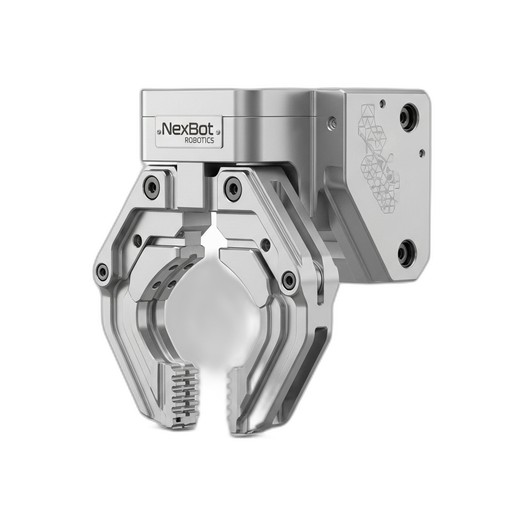
Automatic tool changers, such as the NexBot Vision 421-011, are equipped with multiple sensors to provide this digital confirmation. These are typically non-contact proximity sensors (e.g., inductive or Hall effect) that detect the precise position of the internal locking components. They don't just confirm that an 'unlock' command was sent; they confirm that the mechanism physically achieved a fully locked or fully unlocked state. Common configurations include:
- Lock Position Sensor: A signal is sent to the robot controller only when the locking mechanism is fully engaged.
- Unlock Position Sensor: A separate signal confirms the mechanism is fully disengaged, clearing the robot to move away from the tool stand.
These sensors, often powered by a standard 24VDC supply, provide the discrete I/O signals that serve as the robot's 'eyes and ears' at the wrist. For more advanced 'smart' tooling, some changers also facilitate the pass-through of industrial communication buses, allowing the robot to communicate directly with complex end-effectors like vision systems or servo grippers.
Integrating with Robot Safety Systems
The signals from a tool changer's sensors are not just for operational logic; they are a vital input for the robot's functional safety system. Modern safety standards, such as ISO 13849-1, require a comprehensive risk assessment of the entire robotic cell, and the tool changer is a key component in that assessment.
A dropped tool due to a faulty connection is a significant safety hazard. To mitigate this risk, the signals from the tool changer are integrated into the robot's safety controller. A properly designed system will create a safety interlock: the robot is programmatically prevented from executing high-speed or high-load movements unless the safety controller receives the 'tool locked' signal. If that signal is lost at any point during operation, the system can trigger a safety-rated stop, bringing the robot to a controlled halt.
Redundancy is key. Using two separate signals to confirm the state (e.g., 'locked' signal is ON and 'unlocked' signal is OFF) provides a more robust check than a single signal. This ensures that a single sensor failure or a broken wire doesn't lead to a dangerous condition. The reliability of these safety functions is what allows a 50 kg payload, like that supported by the NXB-GEN-421-011, to be manipulated with confidence.
The Role of Maintenance in Sustained Safety and Performance
Even the most advanced technology requires proper maintenance to ensure its long-term reliability. The precise mating surfaces and internal mechanisms of a tool changer are sensitive to contamination. Dust, metal shavings, grease, and other particulates can impede the locking mechanism or interfere with sensor readings, leading to false signals or incomplete coupling.
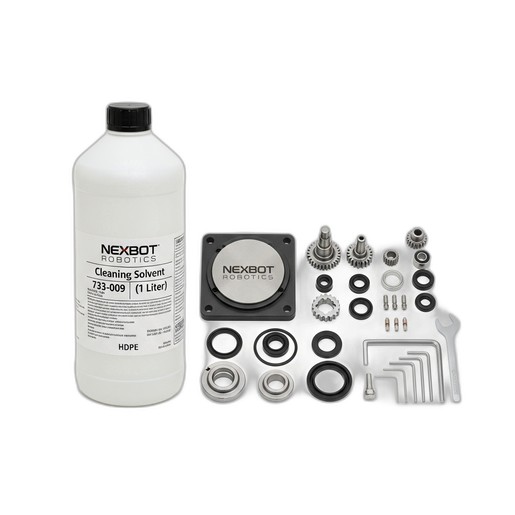
A rigorous preventive maintenance schedule is essential. This includes regular inspection for wear and, crucially, routine cleaning of all mating surfaces on both the robot side and the tool side. Using an appropriate cleaning agent is vital. A solvent must be strong enough to remove industrial grime without damaging the O-rings, seals, and sensitive electrical contacts within the changer. Products like the NexBot Robotics 733-009 Cleaning Solvent are formulated specifically for this purpose, ensuring that maintenance activities enhance, rather than compromise, the component's integrity.
Conclusion: A Critical Component for Modern Automation
Robotic tool changers are far more than simple adapters. They are high-precision safety components that form the critical link between the robot and its work. From the robust mechanical design of a manual changer like the Vision 422-011 to the integrated sensors and safety communication of an automatic model like the Vision 421-011, the underlying technology is focused on one thing: creating a connection that is as reliable and secure as a permanent fixture, but with the flexibility to be changed in seconds. By understanding and respecting the technology within these devices, engineers can build automation systems that are not only more productive but also fundamentally safer.