In the world of industrial robotics, precision, speed, and reliability are paramount. A robot arm executing a flawless weld or a complex assembly sequence is a symphony of coordinated motion. But behind this physical grace lies a hidden, yet critical, infrastructure: the communication network. This digital nervous system is responsible for transmitting every command, sensor reading, and status update with microsecond accuracy.
Many modern robotic systems, however, don't rely on a single, monolithic communication standard. Instead, they employ a layered approach, using different protocols optimized for specific tasks. Two of the most prevalent and powerful protocols in this ecosystem are EtherCAT and IO-Link. While they both facilitate communication, they serve fundamentally different purposes. Understanding their distinct roles is key to designing, operating, and maintaining a high-performance automation cell.
The Backbone: Real-Time Motion with EtherCAT
At the core of any high-performance robot is the need for deterministic, real-time communication. The main robot controller needs to send precise motion commands to multiple servo drives—one for each axis—simultaneously and receive feedback in a tightly synchronized loop. Any delay or jitter in this communication can result in inaccurate movements, reduced performance, or even safety faults. This is the domain of the industrial fieldbus, and EtherCAT (Ethernet for Control Automation Technology) is a dominant force.
EtherCAT operates on a unique principle called 'processing on the fly.' In a traditional Ethernet network, a data packet is sent to a node, which reads it, processes it, and then sends it to the next node. This introduces latency at every step. EtherCAT streamlines this process. An EtherCAT master sends a single frame that travels through all slave devices. Each slave node reads the data addressed to it and inserts its own data into the frame as it passes through, with minimal delay. The frame returns to the master having visited every node in a single, high-speed cycle.
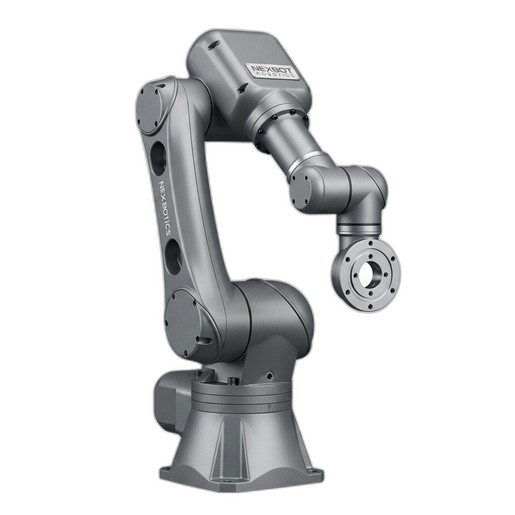
This architecture provides the extremely low latency and deterministic timing required for sophisticated motion control. For a multi-axis robot like the NexBot Robotics FLR022-004 Collaborative Robot Arm, EtherCAT is the ideal backbone. It ensures that all six axes receive their instructions in perfect sync, enabling the fluid, precise motion needed to handle its 10 kg payload with a reach of 1300 mm. Whether it's tracing a complex path or interacting safely with a human operator, the high-speed, synchronized communication provided by EtherCAT is the enabling technology.
The Last Meter: Smart Device Communication with IO-Link
While EtherCAT excels at managing the high-speed nervous system of the robot itself, what about the tools and sensors at the end of the arm? End-of-Arm Tooling (EOAT), like grippers, welders, or finishing tools, requires a different kind of communication. While speed is important, factors like simplified wiring, on-the-fly parameterization, and advanced diagnostics become more critical. This is where IO-Link shines.
IO-Link is not a fieldbus. It is a point-to-point, digital communication protocol designed to connect smart sensors and actuators to a higher-level control system. It operates over standard, unshielded 3-wire cables, dramatically simplifying the complex wiring harnesses often found on robot arms. An IO-Link master device serves as a gateway, collecting data from multiple IO-Link devices and communicating it back to the main controller, often over a fieldbus like EtherCAT.
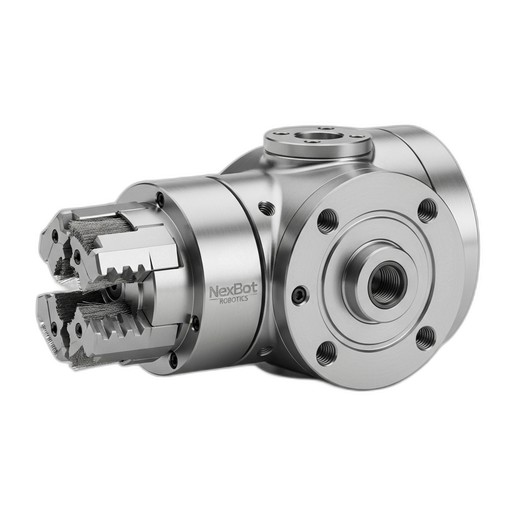
Consider the NexBot Vision 441-003 Rotary Deburring Tool. This is a sophisticated piece of equipment, not a simple on/off device. It features active radial compliance and a high-speed spindle. With IO-Link, the robot controller can do much more than just turn it on. It can:
- Parameterize on the Fly: Adjust the spindle speed (up to 15,000 RPM) for different materials or parts without manual intervention.
- Gather Rich Diagnostics: Monitor the tool's internal temperature, operational hours, or torque feedback. This data is invaluable for predictive maintenance, alerting operators to potential issues before they cause a failure.
- Simplify Swapping: If a tool needs to be replaced, the controller can automatically download the stored parameters to the new device, minimizing downtime and human error.
IO-Link essentially gives a voice to the components at the edge of the system, transforming them from simple peripherals into intelligent, data-rich partners in the automation process.
A Symbiotic System: How They Work Together
EtherCAT and IO-Link are not competitors; they are collaborators. In a typical advanced robotic cell, the FLR022-004 robot arm would be controlled via an EtherCAT network. Mounted on the arm, an EtherCAT IO-Link master module would act as a gateway. The 441-003 deburring tool would then connect to this master via a simple, standard M12 cable.
In this configuration:
- The main PLC or robot controller sends high-speed, synchronized motion commands to the robot's six axes over the EtherCAT network.
- Simultaneously, the controller sends a command (e.g., 'set spindle speed to 12,000 RPM') over EtherCAT to the IO-Link master.
- The IO-Link master translates this and sends it to the deburring tool via the IO-Link protocol.
- The deburring tool confirms the new speed and sends back diagnostic data (e.g., 'current torque is 0.4 Nm') to the master, which then relays it back to the controller over EtherCAT.
This tiered architecture leverages the strengths of both protocols: EtherCAT for the high-speed, time-critical motion control of the robot, and IO-Link for the flexible, data-rich, and simplified communication with the end-effector.
Mastering Maintenance in a Multi-Protocol World
This level of sophistication brings immense benefits in performance and data visibility, but it also requires a new level of skill for maintenance technicians. Troubleshooting a fault requires understanding where one system ends and the other begins. Is a problem caused by a break in the EtherCAT chain, a faulty IO-Link master, or a misconfigured end device?
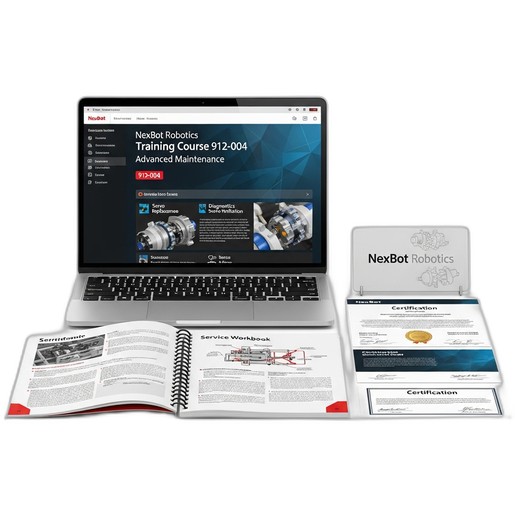
This is why specialized training is essential. A program like the NexBot Robotics Training Course 912-004 Advanced Maintenance is designed specifically to equip technicians with these skills. Over an intensive course, they learn to diagnose issues across the entire system, from interpreting EtherCAT network diagnostics to using IO-Link data to predict component failure. Mastering these protocols is no longer optional; it's a core competency for minimizing downtime and maximizing the ROI of modern robotic assets.
By leveraging the right communication protocol for the right task, we build robotic systems that are not only faster and more precise but also smarter, more flexible, and easier to maintain.