The Pursuit of True Accuracy in Robotics
In the world of industrial automation, the terms 'repeatability' and 'accuracy' are often used, but their distinction is fundamental to a system's success. Repeatability refers to a robot's ability to consistently return to the same point. Accuracy, however, is its ability to go to a specifically commanded point in space. While modern robots boast impressive repeatability, achieving true system-level accuracy—where the robot interacts flawlessly with its environment—is a far more complex challenge. It's a journey that begins with the smallest mechanical components and culminates in sophisticated system-wide integration.
This deep dive explores the three pillars that transform a robot's potential into guaranteed performance: foundational mechanical integrity, expert commissioning, and advanced system integration.
The Foundation: Mechanical Integrity and Precision
Before a single line of code is written, a robot's performance is dictated by its physical construction. The kinematic chain, a series of rigid links connected by joints, is the backbone of robotic motion. Any deviation, looseness, or misalignment in this chain directly compromises the robot's ability to follow its programmed path accurately. Factors like gear backlash, belt tension, and component rigidity are paramount.
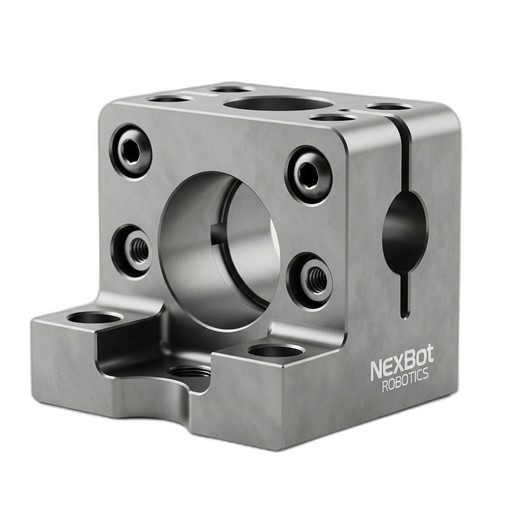
This is where the quality of individual hardware components becomes non-negotiable. Consider the joints, which bear immense stress and are responsible for precise angular positioning. To prevent microscopic slippage that accumulates into significant TCP (Tool Center Point) error, components must be locked with absolute certainty. The NexBot Vision 832-003 Hardened Steel Dowel Pin and Key Set exemplifies this principle. These seemingly simple parts play a critical role in ensuring that motor shafts and joint linkages are perfectly aligned and immovably coupled. Made from hardened alloy steel, they resist shear forces and wear over millions of cycles, guaranteeing that the robot's physical structure remains true to its digital kinematic model. Without this foundational mechanical precision, all subsequent calibration and programming efforts are built on an unstable base.
Bridging the Gap: The Critical Role of Commissioning
A mechanically sound robot is only the first step. To achieve accuracy in a real-world application, the robot's controller must have a perfect understanding of the robot's physical placement and the tooling it carries. This is the core purpose of commissioning.
Professional commissioning is a meticulous process that bridges the gap between the theoretical model and the physical reality of the factory floor. It involves several key steps:
- Mastering and Calibration: Technicians perform fine-tuning procedures to compensate for minor mechanical variations, ensuring all joint encoders report their true angles.
- Payload Definition: The mass, center of gravity, and inertia of the end-of-arm tooling (EOAT) are precisely defined in the controller. Incorrect payload data can lead to motion overshoots, vibration, and inaccurate positioning.
- Tool Center Point (TCP) and User Frame Definition: The TCP—the business end of the tool—is defined with sub-millimeter precision. User Frames are then established to align the robot's coordinate system with key fixtures or workpieces in the cell. An accurate TCP and User Frame are essential for the robot to place parts correctly every time.
- Safety Configuration: Establishing safe operating zones, tool orientation limits, and collaborative safety parameters is crucial for both performance and personnel safety.
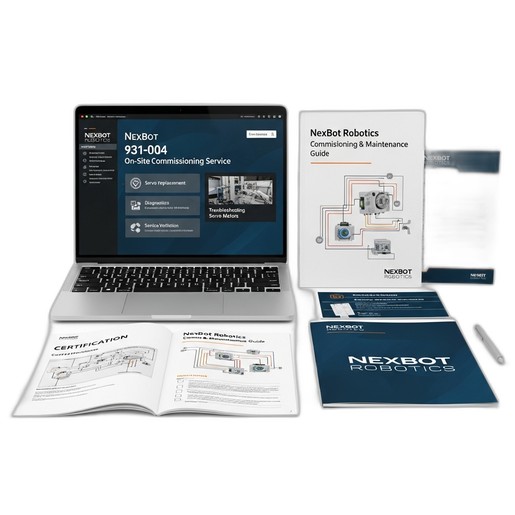
This is where an expert service like the NexBot Robotics 931-004 On-Site Commissioning Service becomes invaluable. NexBot's factory-trained technicians leverage specialized tools and deep system knowledge to ensure every parameter is optimized. They don't just turn the robot on; they integrate it into its environment, transforming its mechanical potential into predictable, accurate, and safe operational performance from day one.
Achieving Synergy: Advanced System Integration
Once a robot is commissioned, it rarely works in isolation. It becomes part of a larger automated system, communicating with PLCs, vision systems, sensors, and other machinery. This is where system integration—the art and science of making disparate components work together as a cohesive whole—comes into play.
Achieving true system accuracy requires seamless data exchange and logic. The robot must react instantly to a signal from a vision camera, signal a PLC when a task is complete, or modify its path based on sensor feedback. This involves mastering:
- Industrial Communication Protocols: Configuring and troubleshooting protocols like EtherNet/IP, PROFINET, or Modbus TCP to ensure reliable, low-latency communication between the robot controller and the master PLC.
- I/O Handshaking: Programming the complex sequence of digital and analog signals that govern the interaction between the robot and its peripheral equipment (e.g., grippers, conveyors, CNC machines).
- Advanced Logic and Error Handling: Developing robust program structures that can handle process variations, manage exceptions, and recover from errors without human intervention.
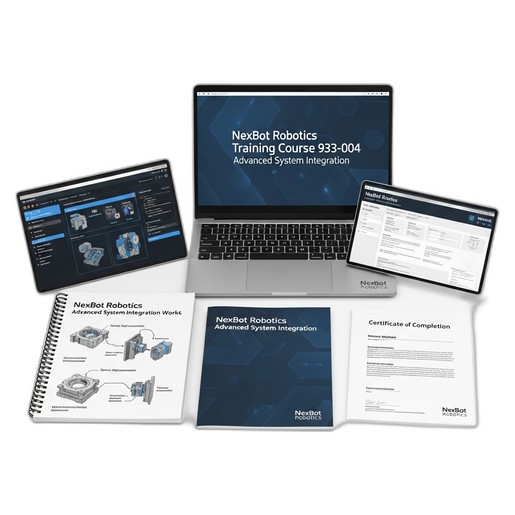
While commissioning lays the groundwork, mastering these advanced topics requires specialized knowledge. The NexBot Robotics Training Course 933-004 Advanced System Integration is designed to empower engineers with this expertise. This hands-on course goes beyond basic robot programming, delving into the nuances of I/O mapping, protocol configuration, and multi-device workflows. Graduates are equipped to design and troubleshoot complex automated cells, ensuring the robot not only moves accurately but also acts intelligently within its integrated environment.
The Complete Picture: A Holistic Approach to Accuracy
Achieving superior performance in industrial robotics is not the result of a single factor. It is the synergy of three critical elements: a mechanically precise foundation built with high-quality components, a perfectly calibrated and configured setup established through expert commissioning, and intelligent, seamless operation orchestrated via advanced system integration. By investing in each stage of this journey, from the dowel pins in the joints to the advanced training of your engineering team, you can unlock the full potential of your automation investment and achieve true system-level accuracy.