In the world of industrial automation, the robotic arm often gets the spotlight. But the true point of contact, the element that interacts directly with your product, is the End-of-Arm Tooling (EOAT). The effectiveness of an entire robotic cell can hinge on the performance of this single component. Choosing the right gripper is not just a hardware decision; it's a strategic choice that impacts throughput, reliability, and product quality.
At NexBot Robotics, we understand that world-class automation is built on a foundation of superior components and expert knowledge. Today, we're spotlighting two of our leading material handling solutions—the ELC412-005 Electric Gripper and the MAG414-005 Magnetic Gripper—and the critical training that empowers integrators to deploy them with maximum effectiveness.
The Power of Precision: The NexBot ELC412-005 Electric Gripper
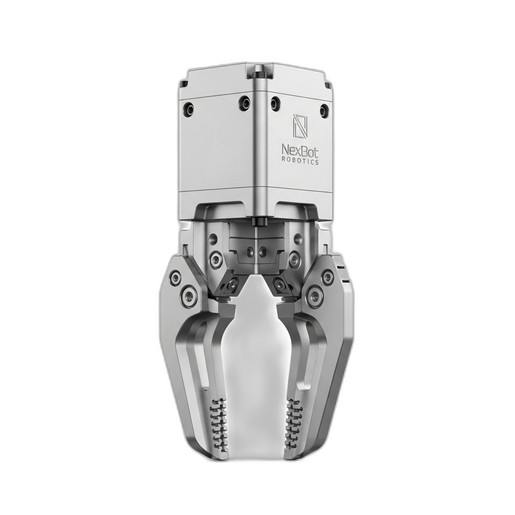
When an application demands precision and adaptability, the electric gripper is the tool of choice. The NexBot ELC412-005 is engineered for tasks where micron-level accuracy is non-negotiable. With a gripping force of 412 N, it has the strength to securely handle a wide range of parts, while its exceptional repeatability of ±0.02 mm ensures that every pick and every place is executed with unerring consistency.
This level of precision makes the ELC412-005 ideal for complex applications such as:
- Electronics Assembly: Handling delicate circuit boards, connectors, and components without causing damage.
- CNC Machine Tending: Accurately loading and unloading parts from machine chucks and fixtures, cycle after cycle.
- Medical Device Manufacturing: Manipulating small, high-value plastic or metal components where quality control is paramount.
- Pick-and-Place Operations: When dealing with parts of varying sizes, the gripper's programmable finger position and force control provide unmatched flexibility.
Powering this performance is a standard 24VDC supply and, critically, an IO-Link communication protocol. IO-Link is the key to unlocking smart functionality. It transforms the gripper from a simple actuator into an intelligent device, providing real-time diagnostic feedback on position, grip status, and internal temperature. This data allows for predictive maintenance and enables on-the-fly adjustments directly from the PLC, dramatically reducing downtime and simplifying integration.
Reliable Strength: The NexBot MAG414-005 Magnetic Gripper
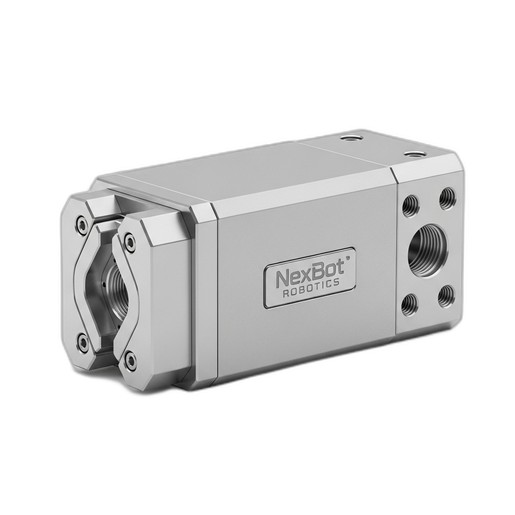
For handling ferrous materials, magnetic grippers offer a unique combination of strength, speed, and reliability. The NexBot MAG414-005 Magnetic Gripper delivers a powerful 140 N of holding force, making it a robust solution for demanding industrial environments. Unlike vacuum or mechanical grippers, magnetic grippers are unaffected by surface imperfections or perforations, allowing them to securely handle sheet metal, stamped parts, and raw steel blanks with ease.
Key applications for the MAG414-005 include:
- Press Tending: Rapidly moving metal sheets in and out of stamping presses.
- Part Bin Picking: Retrieving scattered ferrous parts from a bin without the complexity of finger-based grippers.
- Automotive Assembly: Handling frame components, brackets, and other steel parts on an assembly line.
- De-stacking Operations: Efficiently separating and lifting thin metal sheets from a stack.
The MAG414-005 is designed for durability and simplicity. With no moving fingers, it has fewer wear parts, leading to a longer service life and lower maintenance requirements. Like its electric counterpart, it features IO-Link connectivity. This enables seamless communication with the control system, providing confirmation of part presence and gripper status, which is essential for ensuring safe and reliable automated sequences.
From Hardware to Harmony: The Advanced System Integration Course (NXB-TRN-933-005)
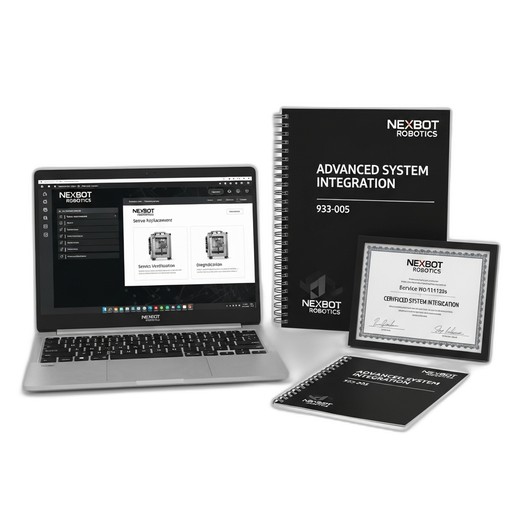
Possessing the industry's best hardware is only half the equation. Unlocking its full potential requires a deep understanding of system design, programming, and multi-device coordination. This is where the NexBot Robotics Training Course 933-005, Advanced System Integration, becomes indispensable.
This intensive 5-day course is specifically designed for system integrators and advanced automation engineers tasked with deploying complex, multi-robot NexBot systems. It goes far beyond basic robot programming. Participants gain hands-on experience in:
- Multi-Robot Cell Design: Architecting layouts for optimal workflow, safety, and efficiency.
- Coordinated Motion Programming: Synchronizing multiple robots to perform complex assembly or transfer tasks.
- Advanced EOAT Integration: Learning the nuances of integrating smart tools like our IO-Link grippers, configuring their parameters, and leveraging their diagnostic data for process optimization.
- Network and PLC Communication: Establishing robust communication protocols between robots, controllers, and higher-level factory management systems.
- Troubleshooting and Optimization: Diagnosing and resolving complex issues in a live multi-robot environment.
By completing this course, an integrator is not just learning how to program a robot; they are learning how to orchestrate a symphony of automated components. They will understand precisely when to specify the ELC412-005 for a high-precision task or the MAG414-005 for a high-speed ferrous handling job. More importantly, they will have the skills to make these components work in perfect harmony with the rest of the system.
The NexBot Advantage: A Complete Solution
Ultimately, success in automation comes from a holistic approach. It requires robust and intelligent hardware like the NexBot grippers, capable of performing reliably under demanding conditions. But it also requires the human expertise to integrate that hardware into a cohesive, efficient, and productive system.
By providing both state-of-the-art End-of-Arm Tooling and the expert-level training needed to deploy it, NexBot Robotics offers a complete solution for mastering your material handling challenges. We empower you not only with the right tools but also with the knowledge to build the future of automation.