In the world of industrial automation, consistency is king. Every minute a robotic cell is offline represents lost productivity and revenue. While modern industrial robots are built for durability, they are not immune to wear and tear. A proactive, structured preventive maintenance (PM) program is not just a best practice; it's a fundamental strategy for maximizing uptime, ensuring operator safety, and protecting your automation investment.
This guide provides a comprehensive checklist, breaking down robot maintenance into key areas and highlighting how quality components play a crucial role in long-term reliability.
The Foundation: Structural Integrity and Mounting
Every precise movement a robot makes begins from its base. A robot's foundation must be perfectly stable and level to guarantee accuracy and repeatability. Any instability at the base is magnified at the end-of-arm tooling (EOAT), leading to positioning errors, inconsistent production quality, and premature wear on the robot's joints.
Maintenance Checklist:
- Torque Checks: Regularly verify that all mounting bolts are torqued to the manufacturer's specifications. Vibrations from robot operation can loosen fasteners over time.
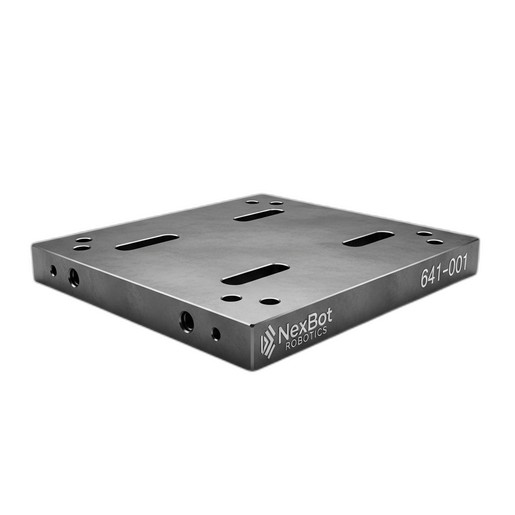
- Leveling: Periodically check that the mounting surface is level. For installations using components like the NexBot Robotics 641-001 Robot Floor Mounting Plate (NXB-MNT-641-001), this ensures the robot's coordinate system remains true.
- Visual Inspection: Examine the mounting plate and surrounding floor for signs of stress, cracking, or corrosion. The robust A36 steel construction of a quality plate provides excellent rigidity, but the surrounding environment can still pose a risk.
A secure foundation is the non-negotiable first step in any reliable robotics system. Don't overlook it.
The Point of Contact: EOAT and Consumables
Nowhere is wear more apparent than at the point of contact with the workpiece. For applications like robotic welding, the consumables within the EOAT are subjected to intense heat and physical stress. These components are designed to be replaced, and adhering to a strict inspection and replacement schedule is critical for maintaining quality.
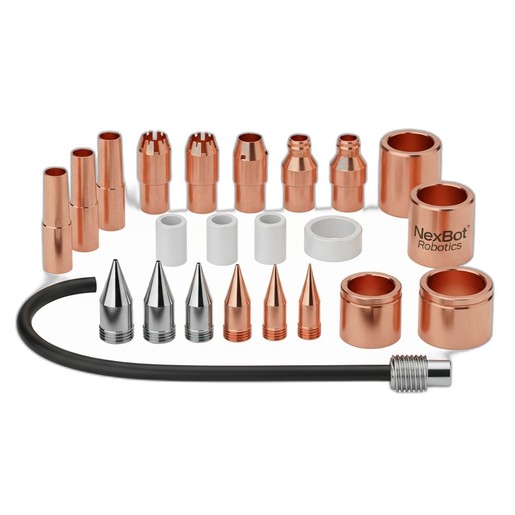
Consider the heart of a MIG welding torch: the contact tip and nozzle. The NexBot Robotics 742-001 Copper M6 Contact Tip and Nozzle Set is a prime example. The high-conductivity copper alloy contact tip is essential for a stable electrical arc, which directly impacts weld quality. As the tip wears, an issue known as 'keyholing' can occur, where the tip's orifice elongates. This leads to poor electrical contact, an erratic arc, and inconsistent wire feeding, resulting in subpar welds.
Maintenance Checklist:
- Frequent Inspection: Visually inspect contact tips and nozzles at the beginning of every shift. Look for spatter buildup, which can obstruct shielding gas flow, and signs of excessive wear.
- Scheduled Replacement: Do not wait for a failure. Establish a replacement interval for contact tips based on your application's arc-on time and amperage. Replacing a consumable part costing a few dollars is far more economical than scrapping an expensive assembly due to a bad weld.
- Proper Installation: Ensure that consumables are installed correctly and tightened to the proper specification. A loose contact tip can cause overheating and premature failure.
The Senses: Sensor Calibration and Care
Modern robots rely on an array of sophisticated sensors to perform complex tasks. Force/torque sensors, in particular, provide the delicate 'sense of touch' required for precision assembly, polishing, and deburring. These sensors enable the robot to adapt to variations in part positioning and apply consistent force.
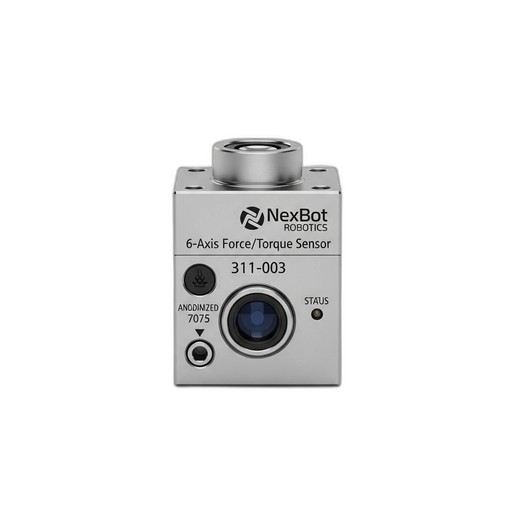
The NexBot Vision 311-003 6-Axis Force/Torque Sensor, for example, provides high-resolution feedback that is essential for advanced control. However, the integrity of this feedback depends on proper care and calibration.
Maintenance Checklist:
- Cable Integrity: The communication cable (often utilizing protocols like EtherCAT) is the sensor's lifeline. Inspect it regularly for signs of abrasion, pinching, or damage from flexing. Ensure connectors are secure and free of contamination.
- Seal Inspection: The sensor's IP67 rating protects it from dust and moisture. Periodically inspect the seals to ensure they are intact, especially in harsh industrial environments.
- Performance Verification & Calibration: While a full recalibration may only be needed annually or after a suspected collision, regular performance verification is key. Program a simple routine to check the sensor's zero-point (tare) and its response to a known load. Any drift or unexpected readings could indicate a problem that needs to be addressed before it impacts production.
A Sample Preventive Maintenance Schedule
Creating a formal schedule transforms maintenance from a reactive task to a proactive strategy. Tailor this template to your specific application and environment.
Daily/Per Shift:
- Visually inspect the robot and EOAT for any obvious damage.
- Check for and clear any error messages on the controller.
- Clean welding nozzles and inspect contact tips for wear.
Weekly:
- Wipe down the robot arm and controller.
- Listen for any unusual noises from joints or motors during operation.
- Perform a more thorough inspection of EOAT, including pneumatic lines and electrical connectors.
Monthly:
- Check the torque of all mounting bolts, including the robot base (NXB-MNT-641-001).
- Inspect all robot cabling for wear, especially at flex points.
- Clean controller cabinet filters.
- Run a diagnostic routine to check sensor readings, like those from the NXB-SNS-311-003.
Annually:
- Perform a full system backup of the robot's software and programs.
- Check and replace batteries in the controller and robot arm.
- Conduct a full system calibration as recommended by the manufacturer.
- Service gearboxes and lubricate joints according to the service manual.
By implementing a robust maintenance plan supported by high-quality replacement parts, you can ensure your robotic systems operate safely, reliably, and profitably for years to come.