Introduction: Beyond the Robot Arm
When we envision an industrial robot, we often picture the articulated arm—a powerful and precise marvel of engineering. However, the true intelligence and effectiveness of a modern automated workcell lie in its 'nervous system': a complex, interconnected network of sensors, safety devices, actuators, and controllers. This system is what allows a robot to not only perform its task but also to perceive its environment, react to changes in real-time, and operate safely alongside human personnel.
At the heart of this nervous system are three critical elements: high-fidelity sensory input, a robust and high-speed communication backbone, and an unwavering safety infrastructure. Understanding how these components are integrated is fundamental to unlocking the full potential of industrial automation. In this article, we will dissect this nervous system, exploring how advanced components and protocols come together to create a cohesive, intelligent whole.
The Sensory Input: A Robot's Sense of Touch
For tasks requiring finesse, such as intricate assembly, polishing, or deburring, a robot operating blindly on pre-programmed paths is insufficient. It needs a sense of touch. This is where multi-axis force/torque sensors come into play. These devices are mounted between the robot arm's wrist and the end-of-arm tooling (EOAT), providing rich, multi-dimensional data about the forces and torques being exerted during an operation.
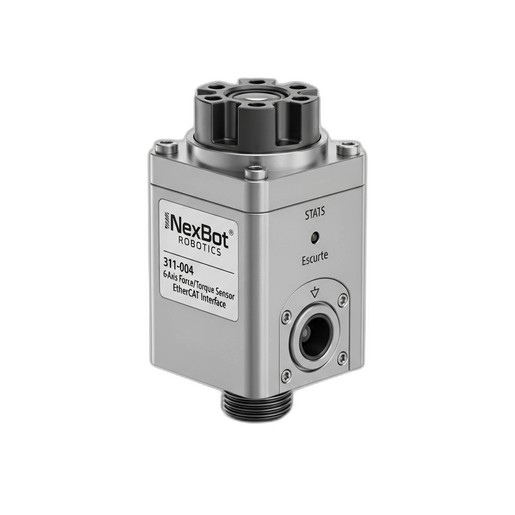
A component like the NexBot Robotics 311-004 6-Axis Force/Torque Sensor provides the granular data necessary for adaptive control. Instead of just moving to a point in space, the robot can now feel its way through a task. For example:
- Assembly: When inserting a peg into a hole, the sensor can detect misalignment as a shear force or torque, allowing the robot controller to make micro-adjustments to find the correct path, preventing jamming and component damage.
- Surface Finishing: During grinding or polishing, the sensor allows the robot to maintain a constant contact force against a contoured surface, ensuring a consistent, high-quality finish even with part-to-part variability.
This high-resolution feedback transforms a rigid automaton into a responsive machine capable of nuanced, adaptive movements. But this valuable data is useless if it cannot be transmitted and processed quickly enough to influence the robot's motion in real-time.
The Communication Backbone: Real-Time Protocols like EtherCAT
This brings us to the communication protocol—the nerve fibers of the robotic cell. Traditional fieldbus systems can introduce latency and jitter (variability in message timing), which are unacceptable for high-performance motion control. This is where real-time industrial Ethernet protocols, such as EtherCAT, become essential.
EtherCAT (Ethernet for Control Automation Technology) offers a deterministic, high-speed solution perfectly suited for robotics. Its unique 'processing-on-the-fly' architecture works differently from standard TCP/IP networks. An EtherCAT master sends a single frame that passes through each slave device (like a sensor, drive, or I/O block). Each slave reads its relevant data and inserts its own data into the frame as it passes through, with minimal delay—often just nanoseconds per node.
This results in several key advantages:
- High Speed: Cycle times can be incredibly short, often well below 1 millisecond, allowing for a near-instantaneous feedback loop between sensor and controller.
- Determinism: Data arrives at a predictable time, every time. This lack of jitter is crucial for synchronizing the motion of multiple axes and ensuring the robot's path controller can act on sensor data from the exact moment it was captured.
- Efficiency: The protocol is highly efficient, utilizing almost all available bandwidth and placing a low processing load on the master controller.
The EtherCAT interface on the NXB-SNS-311-004 sensor is a prime example of this synergy. It ensures that the rich, 6-axis force data is delivered to the robot controller with the speed and reliability needed to execute demanding, force-sensitive applications.
The Protective Reflex: Integrating Safety Systems
No robotic system is complete without a robust safety architecture. This is the system's protective reflex, designed to prevent harm to personnel and equipment. Safety is not an afterthought; it is an integrated layer of the control system that must be as reliable and responsive as the motion control itself.
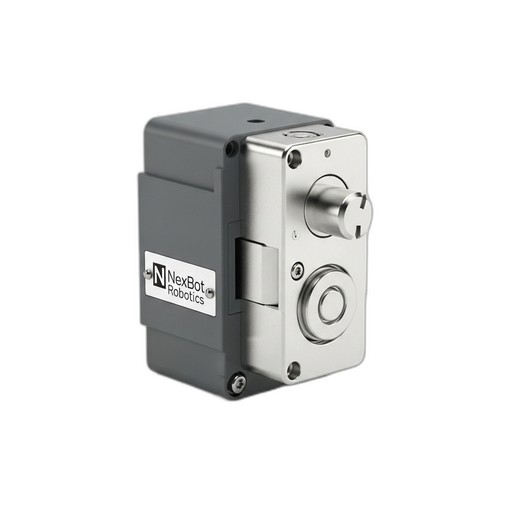
Key components in this layer include light curtains, emergency stop buttons, and safety-rated door interlocks. A device like the NexBot Robotics 621-004 Door Interlock Solenoid Locking switch is a critical element for controlling access to the robotic cell. Its function is twofold:
- Guard Locking: It ensures that the access gate to the cell remains locked while the robot is in operation. The 24VDC solenoid prevents the door from being opened until the robot has reached a safe state.
- Position Monitoring: It sends a positive-break signal back to the safety controller, confirming that the guard is closed. If the door is opened, this signal is interrupted, triggering an immediate and safe stop of all hazardous motion.
These safety signals are typically handled by a dedicated safety controller or safety PLC. This controller constantly monitors the state of all safety devices. When a safety event occurs—like an E-stop being pressed or the interlock on the NXB-GEN-621-004 opening—the controller removes power from the robot's servo drives, bringing the system to a safe halt in accordance with its risk assessment (e.g., ISO 13849).
Tying It All Together: The Art and Science of System Integration
Having state-of-the-art sensors and safety components is only the first step. The true challenge and value lie in integrating them into a cohesive system. This requires a deep understanding of electrical engineering, network configuration, and robot programming. The integrator must ensure that the force sensor data is correctly interpreted by the motion planner, that the EtherCAT network is configured for optimal performance, and that the safety interlock is wired into the safety circuit according to the required performance level.
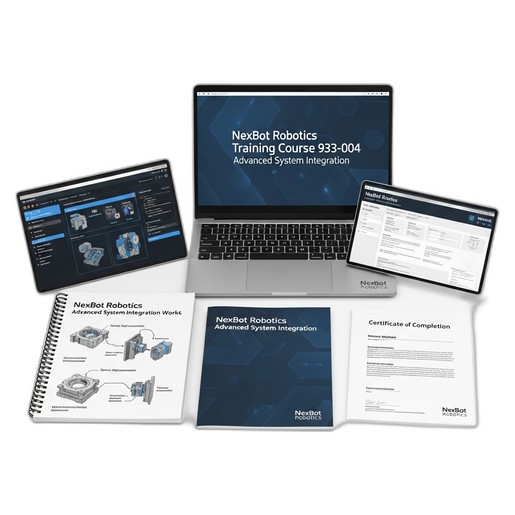
This is where specialized knowledge and training become invaluable. A program like the NexBot Robotics Training Course 933-004 Advanced System Integration is designed to bridge this gap. Such courses provide engineers and technicians with the hands-on experience needed to tackle complex I/O configurations, program adaptive logic based on sensor feedback, and validate safety systems. Mastering system integration is what transforms a collection of high-performance parts into a truly intelligent and productive automated solution.
Conclusion
The modern robotic cell is a testament to sophisticated system integration. Its 'nervous system'—built from precise sensors providing rich data, a high-speed EtherCAT backbone for real-time communication, and an uncompromising safety network—is what defines its capabilities. By understanding how these layers work in concert, we can design, build, and maintain automated systems that are not only faster and more precise but also smarter and safer than ever before.