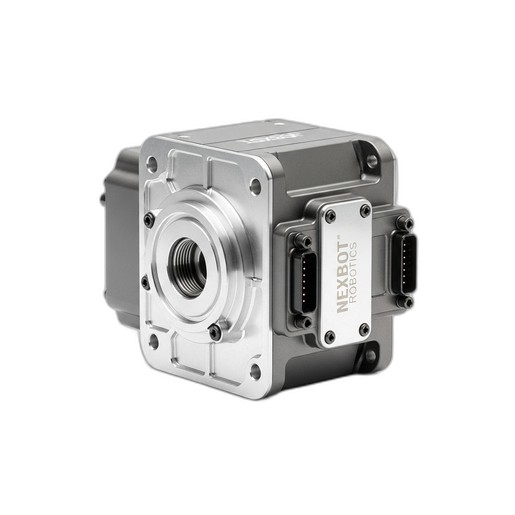
In the world of industrial robotics, precision isn't just a feature—it's the foundation upon which quality, efficiency, and reliability are built. From the delicate assembly of microelectronics to the high-speed execution of pick-and-place routines, the ability of a robot to move to the exact same point, time and time again, is paramount. While the sophisticated control software and powerful motors often take the credit, the unsung hero behind this incredible accuracy is often the gearbox. Today, we're putting the spotlight on a critical component that defines the pinnacle of motion control: the NexBot Harmonic Gearbox HR-30.
Understanding the Harmonic Drive Principle
Before we explore the specific advantages of the HR-30, it's essential to understand what makes a harmonic gearbox, also known as a strain wave gear, so unique. Unlike traditional planetary or spur gear systems that rely on rigid, interlocking teeth, a harmonic drive operates on a principle of elastic deformation. It consists of three primary components:
- Wave Generator: An elliptical bearing assembly that fits inside the Flexspline. As it rotates, it forces the Flexspline to deform into an elliptical shape.
- Flexspline: A thin, flexible, cup-shaped gear with external teeth. It is deformed by the Wave Generator.
- Circular Spline: A rigid, internal ring gear with more teeth than the Flexspline. The Flexspline's teeth engage with the Circular Spline's teeth along the major axis of the ellipse created by the Wave Generator.
The magic happens as the Wave Generator rotates. The ellipse's orientation also rotates, causing the teeth of the Flexspline to progressively engage and disengage with the teeth of the stationary Circular Spline. Because the Flexspline has slightly fewer teeth than the Circular Spline, for every full rotation of the Wave Generator, the Flexspline rotates a tiny amount in the opposite direction. This difference in tooth count creates a very high gear reduction ratio in an incredibly compact space.
The NexBot HR-30 Advantage: Key Features
The NexBot HR-30 isn't just another gearbox; it's an integrated solution designed to be the heart of a robotic joint. It leverages the inherent benefits of strain wave gearing to deliver performance that conventional systems struggle to match.
Zero-Backlash for Unmatched Repeatability
Backlash is the small amount of play or slop between the teeth of meshing gears. In industrial automation, even microscopic backlash can lead to positioning errors, reduced accuracy, and vibrations, especially during changes in direction. The unique operating principle of the HR-30, with its wide area of tooth engagement, naturally eliminates backlash. This zero-backlash characteristic is the key to its exceptional repeatability, ensuring that a robot arm can perform millions of cycles without deviating from its programmed path. This is critical for applications like high-precision assembly, welding, and automated inspection.
High Torque Density and Compact Design
One of the most significant challenges in robot design is managing the trade-off between power and weight. Every gram added to a robot's arm reduces its potential payload or speed. The HR-30 excels here, offering a very high torque-to-weight ratio. It delivers substantial torque capacity and high reduction ratios in a lightweight, compact unit. This allows for the design of smaller, faster, and more energy-efficient robots without sacrificing payload handling capability.
Built for Longevity and Reliability
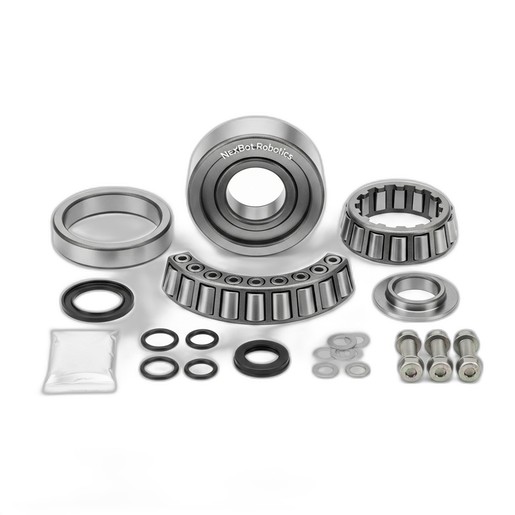
A drive system is only as strong as its weakest link. The HR-30 is engineered for the rigors of continuous industrial use. Its performance is supported by components like the NexBot Robotics 711-001 Joint Bearing. This high-precision tapered roller bearing provides the rigidity needed to handle both radial and axial loads within the joint, ensuring smooth motion and minimizing wear over millions of cycles. This focus on robust internal construction guarantees a long service life and service-friendly maintenance access, reducing downtime and total cost of ownership.
Seamless System Integration with PROFINET
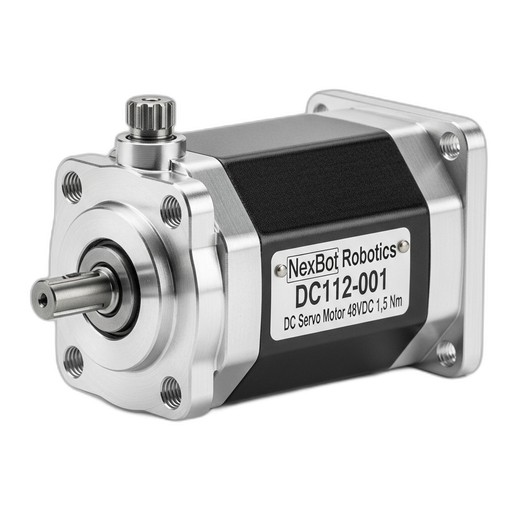
Modern factories are highly connected ecosystems. The HR-30 is designed for this reality, featuring native support for PROFINET, a leading industrial Ethernet standard. This allows for seamless, real-time communication between the drive system and the central plant controller. When paired with a high-performance motor like the NexBot Robotics DC112-001 DC Servo Motor, the PROFINET integration enables precise, synchronized motion control, easy diagnostics, and straightforward commissioning into existing automation networks.
Applications in Action
The superior precision and reliability of the NexBot HR-30 make it the ideal choice for a wide range of demanding industrial applications:
- Electronics Assembly: Placing delicate components onto printed circuit boards with sub-millimeter accuracy.
- Medical and Lab Automation: Handling test tubes, operating syringes, or performing sample analysis where repeatability is non-negotiable.
- Aerospace Manufacturing: Drilling, riveting, and assembling components where tolerances are extremely tight and safety is critical.
- Automated Optical Inspection (AOI): Moving cameras and sensors smoothly and precisely to scan for defects without introducing vibration or positioning errors.
The Heart of the Modern Robot
A robotic joint is a complex synergy of components. The NexBot HR-30 Harmonic Gearbox provides the precise reduction and torque transmission. The NXB-SRV-DC112-001 DC Servo Motor supplies the raw power and responsive control. And the NXB-GEN-711-001 Joint Bearing provides the robust, low-friction support that holds it all together. Together, these elements form a cohesive drive system that delivers the performance required for the next generation of industrial automation.
By choosing the HR-30, engineers are not just selecting a gearbox; they are investing in a foundation of precision that elevates the capability of their entire robotic system. It is this commitment to component-level excellence that unlocks new possibilities in automation, driving industries toward a future of unparalleled efficiency and quality.