In the world of industrial robotics, precision is not a luxury—it is the fundamental requirement upon which productivity, quality, and safety are built. Every movement, from the broad sweep of a palletizing arm to the micro-adjustments of a delicate assembly task, depends on the absolute accuracy and reliability of its core drive components. At the heart of this motion is the servo motor, the muscle that translates digital commands into physical action. Today, we're shining a spotlight on a critical component in this ecosystem: the NexBot Robotics AC111-001 AC Servo Motor, a powerhouse of precision engineered for the demands of modern automation.
The Engine of Accuracy: The AC111-001 Servo Motor
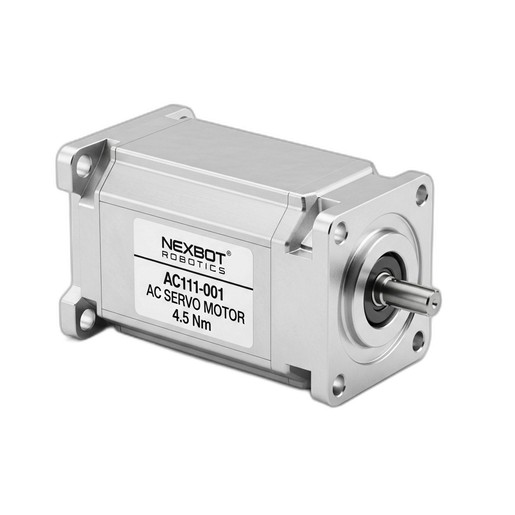
The NXB-SRV-AC111-001 is more than just a motor; it's the foundation for high-performance robotic motion. Designed to operate within demanding industrial environments, it delivers a continuous torque of 4.5 Nm. This level of torque is ideal for a wide range of applications, providing the necessary force for tasks like material handling, CNC machining, and complex pick-and-place operations without sacrificing speed or responsiveness. The motor's dynamic response ensures that robotic arms can accelerate, decelerate, and change direction with minimal latency, which is crucial for maintaining high throughput on a production line.
Operating on a standard 400VAC supply, the AC111-001 integrates seamlessly into common industrial power systems. Its construction features a rugged, IP65-rated housing. This rating signifies that the motor is completely protected against dust ingress and can withstand low-pressure water jets from any direction. In practical terms, this means the AC111-001 is built to last in environments where dust, debris, and washdowns are a part of the daily routine, ensuring long-term reliability and reducing downtime for maintenance.
Seamless Integration and Control with PROFINET
A powerful motor is only as effective as the control system directing it. The AC111-001 utilizes PROFINET, a leading industrial Ethernet standard, for communication. This isn't just a technical detail; it's a strategic advantage. PROFINET enables real-time data exchange between the motor drive and the central controller with high speed and deterministic performance. This ensures that motion commands are executed with microsecond-level precision, allowing for perfectly synchronized movements across multiple axes or even multiple robots. This capability is essential for applications like coordinated welding, collaborative assembly, and high-speed packaging, where timing is everything.
Beyond Motion: Adding Tactile Feedback with the 311-001 Force/Torque Sensor
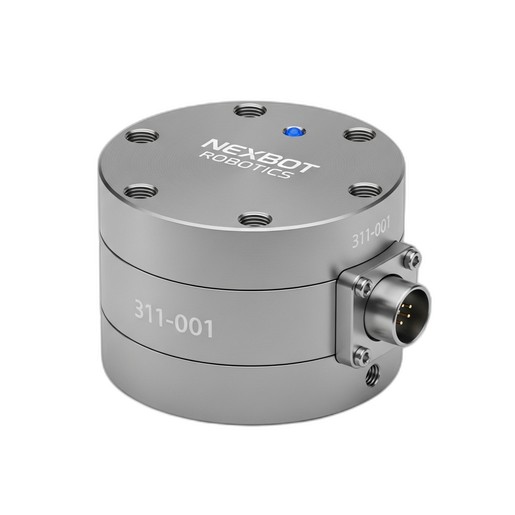
While the AC111-001 provides the power and precision for motion, many advanced robotic tasks require a sense of 'touch'. This is where the NexBot Robotics 311-001 6-Axis Force/Torque Sensor (NXB-SNS-311-001) comes into play. When integrated at the robot's end-effector, this high-resolution sensor provides critical feedback about the forces and torques being exerted during an operation.
Consider a robotic finishing task, such as sanding or polishing a complex surface. The servo motor drives the tool along a programmed path, but the sensor can detect subtle variations in surface pressure. By feeding this data back to the controller in real-time via its high-speed EtherCAT protocol, the system can instantly adjust the motor's position and speed to maintain consistent force. This prevents surface damage, ensures uniform quality, and adapts to part-to-part variability. With a capacity of 500N and 20Nm, and a robust IP67 rating for even greater environmental protection, the 311-001 sensor transforms a powerful robot into a smart, adaptive system.
The Unseen Hero: The Foundation of Reliability
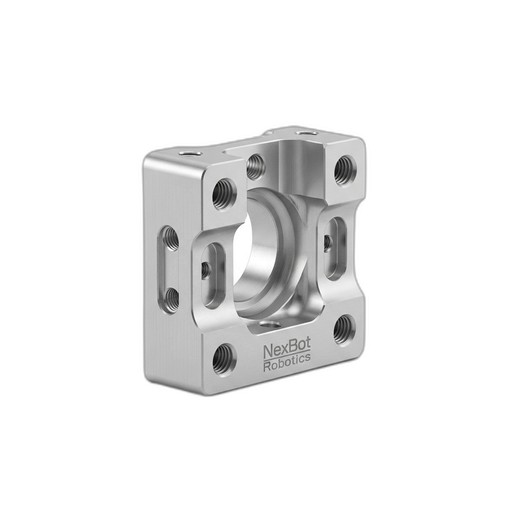
Even the most advanced motor and sensor combination can be undermined by a weak mechanical interface. The NexBot Servo Mounting Bracket for R-20 (NXB-MNT-SRV-R20) is engineered to provide the stable, precise foundation that high-performance components demand. A poorly designed or installed bracket can introduce vibration, misalignment, and mechanical stress, leading to premature wear, positioning errors, and eventual failure.
Our mounting brackets are designed for a perfect fit, ensuring that the AC111-001 servo motor is securely anchored to the robot's structure. This precision alignment is critical for translating the motor's rotational accuracy into linear or articulated motion without loss or error. The bracket's robust construction helps dampen vibrations, protecting the motor's internal components and ensuring consistent performance over millions of cycles. By using specification-driven components like the NXB-MNT-SRV-R20, maintenance teams can ensure service-ready installation and streamline replacement planning, minimizing downtime and maximizing the operational life of the entire robotic cell.
A Complete System for Uncompromising Performance
When viewed together, the AC111-001 Servo Motor, the 311-001 Force/Torque Sensor, and the R-20 Mounting Bracket form a synergistic system. The motor provides the raw power and precise motion. The sensor adds a layer of intelligence and adaptability. The bracket guarantees the mechanical integrity that underpins it all.
This integrated approach allows manufacturers to move beyond simple, repetitive automation and tackle more complex, value-added tasks. From intricate assembly requiring delicate force control to adaptive machining that responds to material variations, this combination of NexBot components provides the building blocks for the next generation of industrial robotics. By focusing on high-quality, interoperable components, we empower engineers and integrators to build robotic systems that are not only powerful and fast, but also smart, reliable, and ready for the challenges of Industry 4.0.