Industrial robots are the backbone of modern manufacturing, performing high-speed, high-precision tasks with relentless consistency. The key to this performance lies in their articulated joints, which bear immense stress cycle after cycle. However, this constant mechanical work inevitably leads to wear, making joint health a critical factor in overall operational efficiency. Unplanned downtime due to joint failure can halt production lines, leading to significant financial losses. The traditional approach of reactive or purely calendar-based maintenance is no longer sufficient. Today, a proactive, data-driven strategy is essential for maximizing uptime and extending the life of these valuable assets.
The Silent Threat: Gradual Joint Degradation
Joint degradation is often a slow, insidious process. It doesn't happen overnight. It begins with microscopic wear on gears, bearings, and seals. Over time, this wear manifests as increased backlash, reduced positional accuracy, and abnormal vibrations. These symptoms can compromise product quality long before a complete mechanical failure occurs. A robot arm that has lost its rigidity might produce out-of-spec parts, apply coatings unevenly, or fail to make consistent welds. By the time these issues are noticeable in the final product, the underlying mechanical problem is often advanced and more costly to repair.
Waiting for a joint to fail—a 'run-to-failure' strategy—is the most expensive form of maintenance. It not only involves the cost of replacement parts and labor but also the far greater cost of lost production. A predictive maintenance program aims to intercept this degradation curve early, allowing for planned interventions that are less disruptive and more cost-effective.
The First Line of Defense: Early Detection with the NXB-SNS-342-005 Vibration Sensor
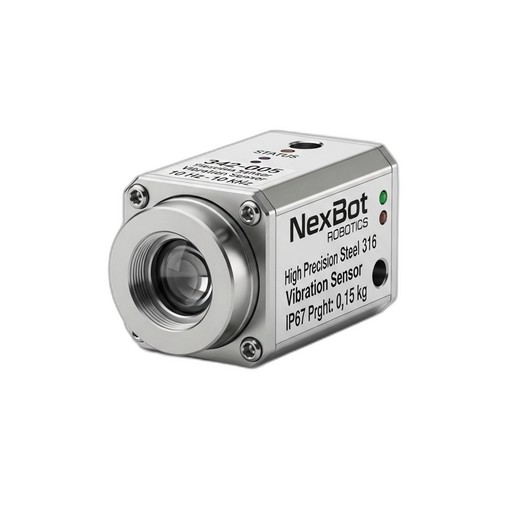
True predictive maintenance starts with high-quality data. To understand the health of a robot joint, you need to listen to it at a vibrational level. The NexBot Robotics 342-005 Vibration Sensor is a high-precision piezoelectric sensor designed specifically for this task.
Mounted on a robot's critical joint housings, the NXB-SNS-342-005 acts as a continuous monitor. Its key advantage is its exceptionally wide frequency range of 10 Hz to 10 kHz. This allows it to detect the full spectrum of mechanical issues:
- Low-Frequency Vibrations (10 Hz - 500 Hz): Often indicate problems like imbalance, misalignment, or structural looseness in the joint assembly.
- Mid-to-High-Frequency Vibrations (500 Hz - 10 kHz): Are critical for identifying early-stage faults in rolling-element bearings and gear teeth, such as microscopic pitting or spalling. These high-frequency signatures are the earliest warnings of impending failure.
By capturing this rich data, maintenance teams can establish a healthy baseline for each joint and then use trend analysis to spot deviations. An increase in vibration amplitude at a specific frequency can pinpoint the exact nature of the developing fault. The sensor's 24VDC power requirement and IO-Link communication protocol ensure seamless integration into modern control architectures, allowing for the easy transmission of diagnostic data to a PLC or higher-level monitoring system without the need for complex analog wiring.
The Definitive Solution: Restoring Rigidity with the NXB-KIT-762-003 Joint Overhaul Kit
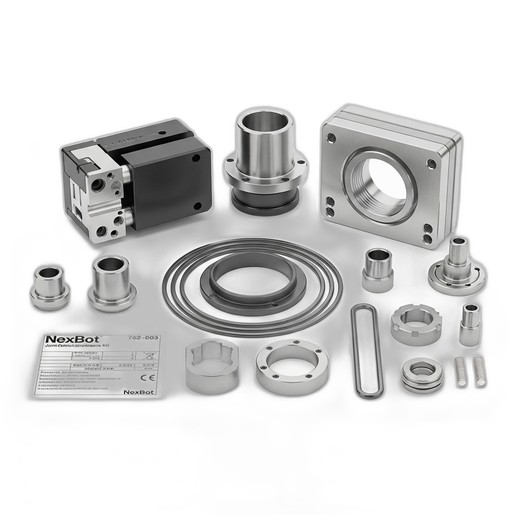
Once the vibration sensor data indicates that a joint requires service, a precise and comprehensive repair is necessary to restore it to factory specifications. This is where the NexBot Vision 762-003 Joint Overhaul Hardware Kit becomes indispensable for maintenance on NexBot R-Series robots.
This is not just a collection of miscellaneous bolts; it's an engineered solution designed to address every critical aspect of joint integrity. The contents are carefully specified to ensure a successful overhaul:
- Grade 12.9 High-Tensile Socket Head Cap Screws: These provide the superior clamping force required to hold the joint assembly together under extreme dynamic loads, preventing slippage and maintaining rigidity.
- Hardened Steel Precision Alignment Dowels: Proper alignment is non-negotiable for robot accuracy. These dowels ensure that the gearbox and motor components are perfectly concentric, minimizing stress and premature wear.
- Stainless Steel Shim Set: Over time, backlash can develop in the gear train. This precision shim set (0.05mm, 0.10mm, 0.25mm) allows technicians to precisely set the gear mesh and eliminate slop, restoring the robot's positional accuracy.
- Vibration-Resistant Lock Washers: These specialized washers prevent fasteners from loosening under the constant vibration of robot operation, a common cause of recurring mechanical issues.
- Joint Access Cover Plates: Fresh plates and seals ensure the joint's internal components remain free from contamination after the service is complete.
Using the NXB-KIT-762-003 ensures that every critical component is replaced with parts that meet or exceed original specifications, effectively resetting the joint's service life.
Integrating the System: The Role of I/O Modules
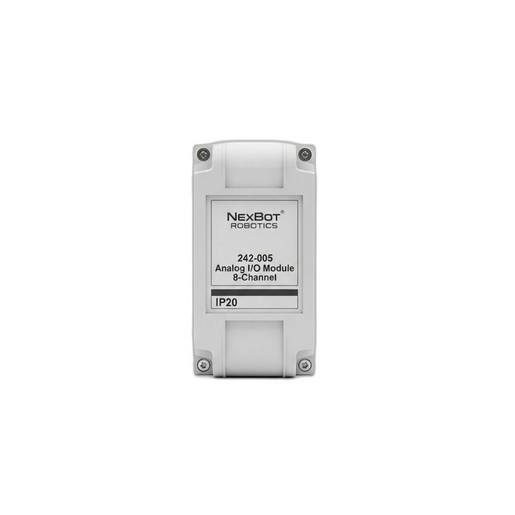
The data from sensors and the health of the robot are only useful if they can be communicated effectively to the central control system. While the NXB-SNS-342-005 sensor uses the advanced IO-Link digital protocol, a robust I/O infrastructure is vital for the entire automation cell. The NexBot Robotics 242-005 Analog I/O Module provides a reliable 8-channel interface for integrating other crucial sensors—such as temperature or pressure monitors—that may be part of the overall cell health monitoring strategy. A stable and well-organized I/O system is the foundation upon which effective data collection and predictive maintenance programs are built.
A Complete Ecosystem for Robot Longevity
By combining early, precise detection with comprehensive, engineered repair solutions, NexBot Robotics provides a complete ecosystem for managing robot joint health. The NXB-SNS-342-005 Vibration Sensor is the diagnostic tool that identifies problems before they impact production, while the NXB-KIT-762-003 Joint Overhaul Kit is the prescriptive solution that restores performance. This integrated approach transforms maintenance from a reactive, costly fire-fight into a planned, proactive strategy that maximizes robot availability, ensures consistent product quality, and delivers a superior return on your automation investment.