The High Cost of Reactive Maintenance
In any automated facility, the rhythmic motion of industrial robots is the heartbeat of production. When that heartbeat stops unexpectedly, the entire operation flatlines. Traditional maintenance strategies often fall into two camps: reactive (fix it when it breaks) or preventive (fix it on a fixed schedule). While preventive maintenance is a step up from being purely reactive, it has its own drawbacks. You might replace components that still have significant operational life left, incurring unnecessary costs, or fail to catch a component that fails before its scheduled replacement, leading to the very downtime you sought to avoid.
Unplanned downtime is more than just an inconvenience; it's a cascade of costs. Lost production, wasted materials, idle labor, and potential damage to other equipment can quickly erode profitability. The key to escaping this cycle is to gain insight into the health of your robotic systems in real-time. This is the core principle of predictive maintenance (PdM).
Shifting to a Predictive Model
Predictive maintenance uses data analysis tools and techniques to detect anomalies in your operation and processes so that you can fix them before they result in failure. Instead of relying on schedules or waiting for a breakdown, a PdM strategy allows you to listen to what your robots are telling you. By continuously monitoring key performance indicators like vibration, force, and temperature, you can identify the subtle signs of developing faults long before they become catastrophic failures.
This data-driven approach allows for smarter maintenance planning. Repairs can be scheduled during planned downtime, parts can be ordered just-in-time, and maintenance resources can be allocated more efficiently. The result is a dramatic increase in Overall Equipment Effectiveness (OEE), a longer lifespan for your assets, and a more resilient production line.
Key Technologies for Predictive Maintenance
Implementing a successful PdM program relies on collecting high-quality, consistent data. This is where specialized sensors and robust I/O systems become critical. By outfitting your robotic workcells with the right monitoring hardware, you can build a comprehensive picture of each asset's health.
Vibration Analysis: Detecting Trouble Early
One of the most powerful tools in the PdM arsenal is vibration analysis. Every mechanical system, including a robotic arm, has a unique vibration signature during normal operation. Deviations from this baseline signature are often the earliest indicators of mechanical issues.
- Bearing Wear: A failing bearing will introduce distinct frequencies into the vibration spectrum.
- Gear Mesh Problems: Worn or misaligned gears in a robot's joints create specific vibration patterns.
- Structural Looseness: Loose bolts or cracks in the robot's structure can be detected as low-frequency vibrations or rattles.
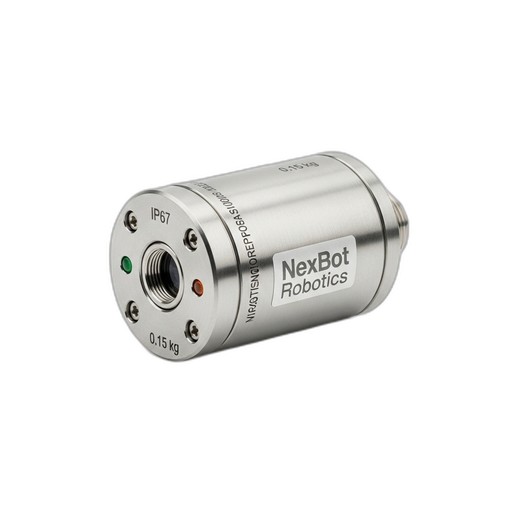
A high-sensitivity sensor like the NexBot Robotics 342-004 Vibration Sensor (NXB-SNS-342-004) is designed for this exact purpose. Its IEPE (Integrated Electronics Piezo-Electric) design provides a clean, stable 100 mV/g signal, allowing your monitoring system to detect even minute changes in the robot's mechanical behavior. With an IP67 rating, it's built to withstand the harsh coolants, dust, and washdowns common in industrial environments, ensuring reliable data collection where you need it most.
Force and Torque Monitoring: Understanding the Workload
While vibration tells you about the health of the mechanical components, monitoring force and torque provides insight into the application itself. A robot is designed to perform a task with a specific amount of force. Unexpected changes can signal a problem with the robot, its end-of-arm tooling (EOAT), or the workpiece.
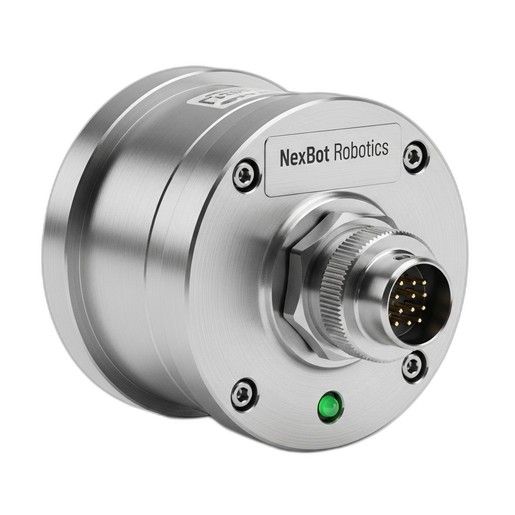
By integrating a sensor like the NexBot Robotics 311-005 6-Axis Force/Torque Sensor (NXB-SNS-311-005) at the robot's wrist, you can monitor for:
- Increased Joint Friction: A failing motor or gearbox in a joint may require more effort to move, showing up as an anomaly in the force/torque data.
- Tooling Misalignment: If a gripper or tool is misaligned, it will exert unexpected side-loads or torques during an operation.
- Collision Detection: The sensor can instantly detect impacts that may be too subtle for the robot's built-in systems, allowing for immediate inspection and preventing further damage.
The real-time data provided over a high-speed protocol like EtherCAT is crucial for both process control and predictive maintenance, creating a dual-purpose data stream that enhances quality and reliability.
The Role of I/O in Data Integrity
Sensors are the eyes and ears of your PdM system, but their data is only useful if it reaches your control or monitoring system accurately and reliably. This is the critical function of Input/Output (I/O) modules. They act as the nervous system, translating sensor signals into data the robot controller or PLC can understand.
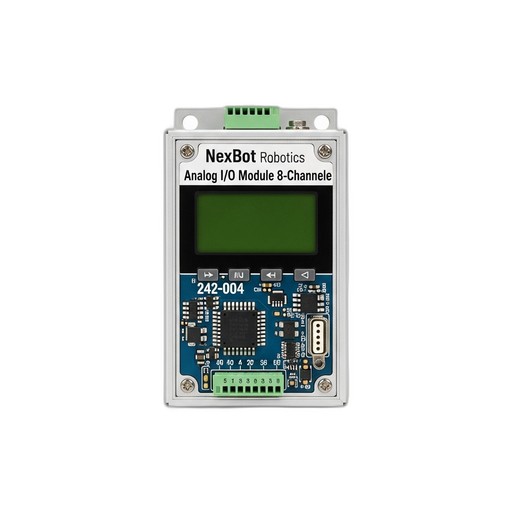
The NexBot Robotics 242-004 Analog I/O Module (NXB-GEN-242-004) is a vital link in this chain. It provides 8 channels for connecting various analog sensors, ensuring that the nuanced data from vibration, pressure, or temperature sensors is converted with high fidelity. A stable, reliable I/O module prevents data dropouts or signal noise that could lead to false alarms or, worse, missed warnings. Planning for service-ready and specification-driven modules ensures that your data acquisition infrastructure is as robust as the robots it monitors.
Building Your Predictive Maintenance Strategy
- Identify Critical Assets: Start with the robots whose failure would cause the most significant production disruption.
- Establish a Baseline: Once sensors are installed, run the robot through its normal cycles to collect baseline data. This 'healthy' signature is the benchmark against which all future data will be compared.
- Set Alert Thresholds: Work with your team to define what level of deviation from the baseline constitutes a warning (requiring inspection) versus a critical alert (requiring immediate action).
- Integrate and Automate: Feed the sensor data into a monitoring system (like a SCADA or dedicated condition monitoring software). Automate alerts to ensure maintenance personnel are notified promptly.
- Analyze and Refine: As you collect more data, you will refine your understanding of failure modes and improve the accuracy of your predictions. This continuous improvement loop is the hallmark of a mature PdM program.
By investing in a sensor-based, data-driven maintenance strategy, you transform your maintenance department from a cost center into a proactive, value-driving part of your operation. Listening to your robots is the first step toward a more reliable and profitable future.