The Evolution of Robotic Communication
In the world of industrial automation, speed, precision, and reliability are the pillars of productivity. For decades, industrial robots operated on serial fieldbus protocols, which were revolutionary for their time but are increasingly strained by the demands of Industry 4.0. Today's smart factories require massive data throughput, synchronized multi-axis motion, and seamless integration between robots, sensors, and enterprise-level systems. This demand has driven the adoption of Industrial Ethernet protocols, with PROFINET emerging as a leading standard for high-performance automation.
PROFINET is more than just 'Ethernet for the factory floor.' It's a sophisticated communication standard that leverages the ubiquity of Ethernet technology while adding the critical elements of determinism and real-time data exchange. This article will explore the fundamentals of PROFINET in robotics, its impact on performance, and how the underlying physical and human systems are essential to its success.
What is PROFINET?
PROFINET (Process Field Network) is an open technical standard for data communication over Industrial Ethernet. At its core, it's designed to deliver data from controllers to devices like robot arms, sensors, and servo drives with predictable, repeatable timing. Unlike standard office Ethernet, where a slight delay in an email is inconsequential, a millisecond of latency in a robotic application can lead to positioning errors, collisions, or flawed products.
PROFINET achieves this through several key mechanisms:
- Real-Time (RT): This class of communication prioritizes PROFINET data packets, allowing them to bypass the standard TCP/IP stack for faster processing. This is suitable for most typical I/O applications with update times in the range of a few milliseconds.
- Isochronous Real-Time (IRT): For the most demanding applications like high-speed coordinated motion control, IRT uses a time-slotted, hardware-based approach. This reserves specific bandwidth for cyclic data, guaranteeing delivery within a precise time window, often in microseconds. This determinism is what allows multiple robots to perform complex, synchronized tasks flawlessly.
- Decentralized Architecture: PROFINET allows for a more flexible, decentralized system architecture. Devices can be connected in various topologies (line, star, ring) without requiring complex gateways, simplifying plant layouts and reducing wiring costs.
The Physical Layer: Protecting the Data Lifeline
The theoretical speed and determinism of PROFINET are meaningless if the physical connection is unreliable. A robot arm is a dynamically hostile environment for cabling. Constant flexing, torsion, and exposure to industrial contaminants can quickly degrade a standard Ethernet cable, leading to intermittent signal loss, packet drops, and difficult-to-diagnose production halts. The integrity of the data stream is paramount.
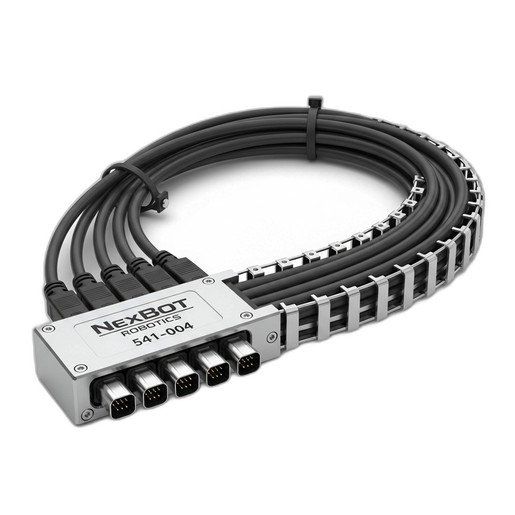
This is where specialized cable management solutions become critical. The NexBot Robotics 541-004 Cable Carrier is engineered specifically for this challenge. A high-quality cable carrier, or drag chain, serves several vital functions:
- Prevents Fatigue: It ensures that cables bend only within their specified minimum bend radius, preventing the internal conductors from fatiguing and breaking over millions of cycles.
- Reduces Abrasion: The carrier provides a smooth, protective conduit that prevents cables from rubbing against abrasive machine surfaces or each other.
- Maintains Signal Integrity: By organizing and protecting the PROFINET cables, it helps shield them from electromagnetic interference (EMI) from nearby power cables, which can corrupt data and degrade network performance.
Investing in a robust physical layer with a properly specified cable carrier is not an accessory; it's a foundational requirement for leveraging the full power of a high-speed protocol like PROFINET.
Integrating Mechanical and Digital Performance
A high-performance communication protocol is the robot's nervous system, but its commands must be executed by a healthy mechanical body. The precise, high-acceleration movements commanded over a PROFINET network place immense stress on the robot's joints, bearings, and gearboxes. Without proper maintenance, this digital precision is lost to mechanical slop, friction, and eventual failure.
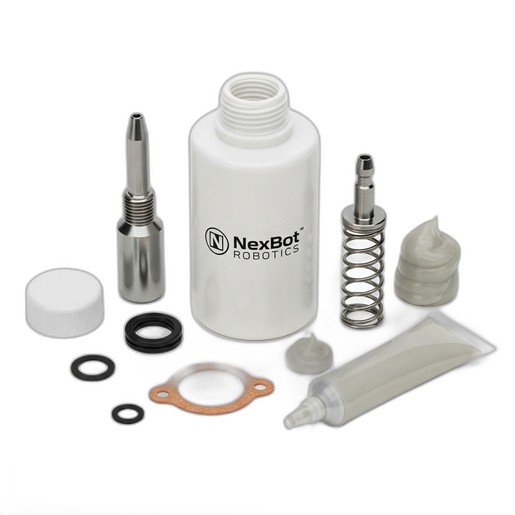
Lubrication is a cornerstone of mechanical reliability. The intense, repetitive motions can quickly break down generic greases, leading to increased friction, heat, and wear. This can manifest as 'stick-slip' motion, where the joint momentarily seizes and releases, destroying the smooth path control that IRT communication enables. To prevent this, a specification-driven lubricant is essential. The NexBot Vision 731-003 Joint Grease Cartridge is formulated for the high-load, high-cycle demands of modern industrial robots. Using the correct grease as part of a planned maintenance schedule ensures that the robot can physically execute the precise commands it receives, translating digital accuracy into real-world mechanical precision.
The Human Element: Training for Integrated Systems
As robotic systems become more integrated, so too must the skills of the technicians who maintain them. An error message for 'axis out of position' is no longer a simple mechanical or electrical problem. The root cause could be:
- A network issue (e.g., a faulty switch or high packet latency).
- A physical layer problem (e.g., a damaged cable within the carrier).
- A drive or motor fault.
- A mechanical binding issue due to improper lubrication.
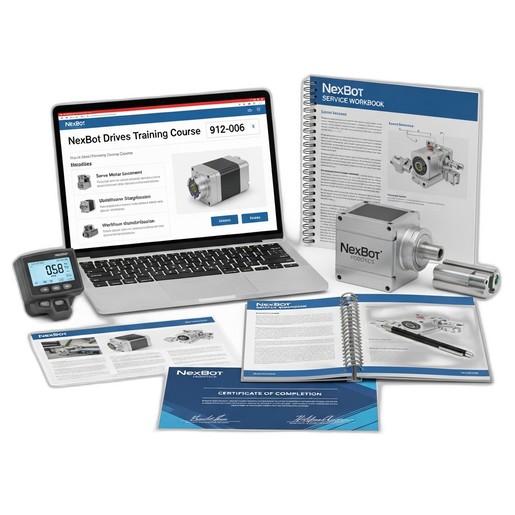
Troubleshooting these complex, interconnected systems requires a holistic skill set. This is why targeted training is so valuable. The NexBot Drives Training Course 912-006 provides technicians with the comprehensive knowledge needed to navigate these challenges. The course covers not just the replacement of a servo motor but also the diagnostic workflows to correctly identify the source of a problem, whether it's in the software, network, or hardware. Standardizing these maintenance workflows ensures that problems are diagnosed correctly the first time, minimizing downtime and preventing the costly cycle of trial-and-error parts replacement.
Conclusion: A System of Systems
PROFINET represents a significant leap forward in robotic control, enabling levels of speed, coordination, and integration previously unimaginable. However, unlocking its full potential requires looking beyond the protocol itself. True performance is achieved when the digital nervous system is supported by a robust physical layer, maintained with precision consumables, and managed by highly skilled personnel. By integrating robust components like the NexBot cable carrier, specification-driven lubricants, and comprehensive training programs, manufacturers can ensure their automation systems operate not just at their theoretical peak, but with the day-in, day-out reliability that drives modern industry.