The Unseen Dance of Industrial Automation
In the heart of any modern manufacturing facility, industrial robots perform their tasks with a speed and precision that can seem almost magical. This intricate dance—a perfectly executed weld, a delicate component placement, a heavy payload lifted with grace—is the result of a sophisticated discipline: motion control. Motion control is the technological core that translates digital commands into precise, physical movement. It's a complex synergy of robust mechanical hardware, intelligent software algorithms, and intuitive human interfaces. Understanding this system is key to unlocking the full potential of automation, improving efficiency, and ensuring operational reliability. In this deep dive, we will dissect the fundamental layers of robotic motion control, from the hardened steel components that bear the load to the advanced software that choreographs every action.
The Mechanical Foundation: From Power to Position
Before a single line of code is executed, a robot's capacity for precision is defined by its physical construction. The ability to move smoothly, stop accurately, and repeat a motion millions of times without deviation rests on the quality of its mechanical components. Two critical elements in this foundation are the power transmission system and the guidance system.
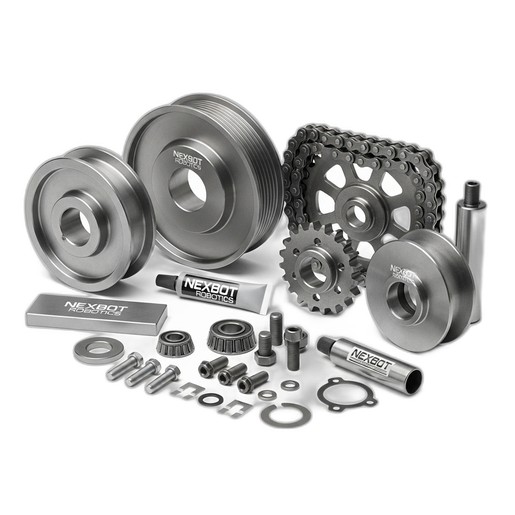
Power Transmission: At each joint of a robotic arm, motors generate torque that must be translated into controlled movement. This is where components like the NexBot Robotics 722-004 Pulley and Sprocket Set become indispensable. Crafted from hardened steel, these sets are designed to engage with timing belts to transmit power with minimal loss and high fidelity. The material choice is crucial; hardened steel resists wear and deformation under high-cycle, high-load conditions, ensuring that the relationship between motor rotation and joint articulation remains constant over the robot's lifespan. This minimizes backlash—the small amount of slop or lost motion in a mechanism—which is a primary enemy of robotic accuracy.
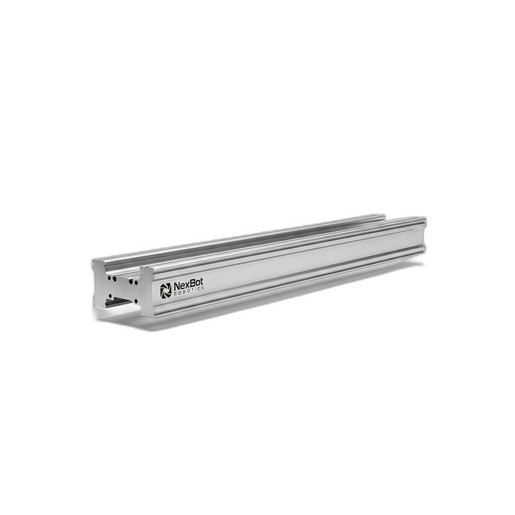
Guidance and Trajectory: While joints provide articulation, many applications require precise movement along a defined, often lengthy, path. This is the domain of linear motion systems. The NexBot Drives 643-006 Linear Rail Track provides a rigid, low-friction guideway for a robot or its end-effector. These tracks, often called a 'seventh axis,' extend a robot's work envelope dramatically, allowing it to service multiple workstations or manage large workpieces. The precision-ground surfaces of the rail and the corresponding bearing blocks ensure that movement is perfectly straight and smooth, eliminating unwanted deviation and vibration that could compromise the task, whether it's dispensing a sealant, performing an inspection, or transferring parts between conveyors.
Together, these mechanical systems form the robot's kinematic chain—the assembly of rigid bodies and joints that define its potential for movement. The integrity of this chain is the bedrock upon which all software control is built.
The Brains of the Operation: Algorithms and Trajectory Planning
With a robust mechanical structure in place, the next layer is the control intelligence. The robot's controller runs complex algorithms that perform a series of critical calculations in real-time. The goal is to take a simple command, such as "move tool to position X, Y, Z," and translate it into the precise, coordinated sequence of motor commands required to get there.
Inverse Kinematics: This is one of the most fundamental calculations in robotics. The controller knows the length of each arm segment and the position of each joint (forward kinematics). To move the end-effector to a desired point in space, it must calculate the required angle for each of those joints—a complex trigonometric problem known as inverse kinematics. The controller solves these equations hundreds of times per second to create a smooth path.
Trajectory Planning: Simply knowing the start and end points isn't enough. The controller must also plan the path between them, defining the velocity and acceleration profiles to ensure the movement is smooth, fast, and stable. This prevents jerky motions that could damage the payload or the robot itself. Advanced algorithms can even optimize paths to avoid obstacles or minimize energy consumption.
PID Control Loops: At the lowest level, for each motor, a control loop (most commonly a Proportional-Integral-Derivative, or PID, loop) constantly works to eliminate errors. It compares the motor's actual position (read from an encoder) to its commanded position and calculates the necessary voltage adjustment to correct any deviation. This continuous feedback loop is what allows a robot to hold a position steadily against gravity or to follow a path with sub-millimeter accuracy.
The Human-Machine Interface: Commanding Precision
The most sophisticated control system is ineffective without a clear and efficient way for an operator to program and interact with it. This is the role of the Human-Machine Interface (HMI), and for robots, the most essential HMI is the teach pendant. It is the bridge between human intent and machine execution.
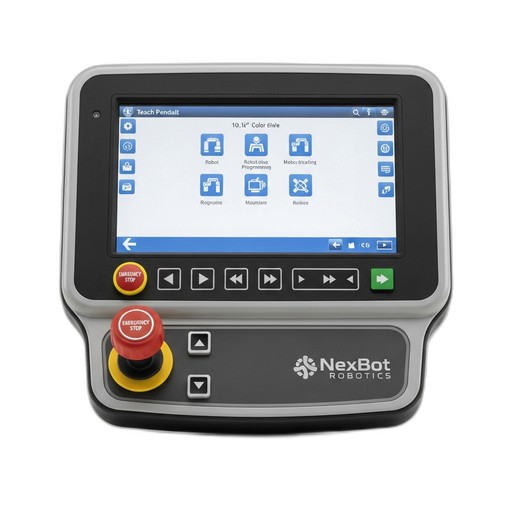
The NexBot Drives 221-006 Teach Pendant exemplifies the features of a modern HMI. Its large, responsive touchscreen allows programmers to visualize the robot's digital twin, set waypoints with graphical precision, and write or modify program logic through an intuitive interface. An operator can use the pendant's physical joysticks to manually 'jog' the robot into position, teaching it the exact points required for a task. The data from these taught points is then used by the controller's trajectory planner to build the automated routine.
Ergonomics and durability are paramount. An IP65-rated, drop-resistant housing ensures the pendant can withstand the rigors of the factory floor. This reliability is critical, as the teach pendant is not just a programming tool but also a primary safety and diagnostic device, giving operators direct control and real-time feedback on the robot's status.
A System in Harmony
True robotic precision is not the result of a single superior component but the seamless integration of all these layers. An operator uses the intuitive interface of the Teach Pendant to define a path. The controller's software takes this input, performs complex kinematic and trajectory calculations, and sends commands to the motors. These commands are translated into physical motion through high-fidelity Pulleys and Sprockets at the joints, while the entire arm may be moving along a stable Linear Rail Track. Encoders provide constant feedback to the controller, which refines its commands in real-time to ensure the end-effector follows the programmed path with extraordinary accuracy. It is this complete, harmonious system that enables the powerful and precise automation transforming industries today.