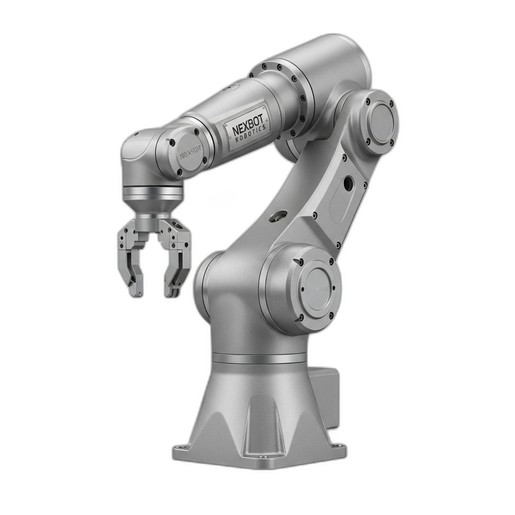
Industrial robots are the cornerstone of modern manufacturing, celebrated for their ability to perform tasks with a level of speed and precision that far surpasses human capability. But what is the science behind this remarkable accuracy? It's not a single component, but a sophisticated synergy between mechanical engineering, electrical systems, and advanced software. In this deep dive, we'll dissect the critical elements that enable a robot like the NexBot R-20 to execute its tasks flawlessly, focusing on the roles of its drive system, its communication network, and how they combine to create a symphony of controlled motion.
The Mechanical Heart: Precision in Motion with Harmonic Gearboxes
At the core of every robotic joint is a drive system responsible for converting electrical energy into precise physical movement. While motors provide the initial power, it's the gearbox that refines this power into the high-torque, controlled motion required for heavy lifting and intricate tasks. For high-precision applications, harmonic gearboxes are the industry standard.
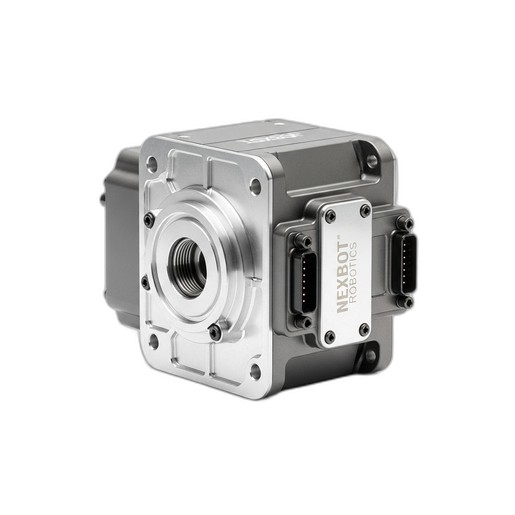
The NexBot Harmonic Gearbox HR-30 is a prime example of this technology. Unlike traditional planetary or spur gear systems, harmonic drives operate on a unique principle involving a flexible, tooth-lined cup that deforms to engage with an outer ring. This design offers several key advantages:
- Zero Backlash: Backlash, the tiny gap between gear teeth, is a major source of positional error and 'slop' in motion. The continuous engagement of a harmonic gearbox virtually eliminates backlash, resulting in exceptionally smooth, repeatable, and accurate movements.
- High Torque Density: These gearboxes can transmit immense torque relative to their compact size and low weight. This allows for smaller, lighter robotic arms that can still handle significant payloads, like the 50kg capacity of the NexBot R-20.
- High Gear Ratios in a Single Stage: Harmonic drives achieve high reduction ratios in a single, compact stage, simplifying the robot's mechanical design and reducing potential points of failure.
When integrated into an articulated robot, these characteristics mean that the command sent to the motor is translated into physical motion with near-perfect fidelity. The result is the sub-millimeter repeatability that is essential for tasks like welding, assembly, and machine tending.
The Digital Nervous System: Real-Time Communication with PROFINET
An advanced mechanical system is only as good as the signals controlling it. In a complex factory environment, a robot must communicate seamlessly with a central controller (PLC), vision systems, sensors, and other machinery. This requires a communication protocol that is not just fast, but deterministic—meaning data arrives exactly when it's expected, every single time. This is where industrial Ethernet protocols like PROFINET come into play.
PROFINET is the digital nervous system of the modern automated cell. It operates in real-time, ensuring that motion commands are transmitted from the robot controller to the arm's servo drives with microsecond-level synchronization. This is critical for coordinating the movement of all six axes of an articulated robot to follow a precise path in three-dimensional space. Any latency or 'jitter' in the communication would lead to deviations from the programmed path, ruining the task at hand.
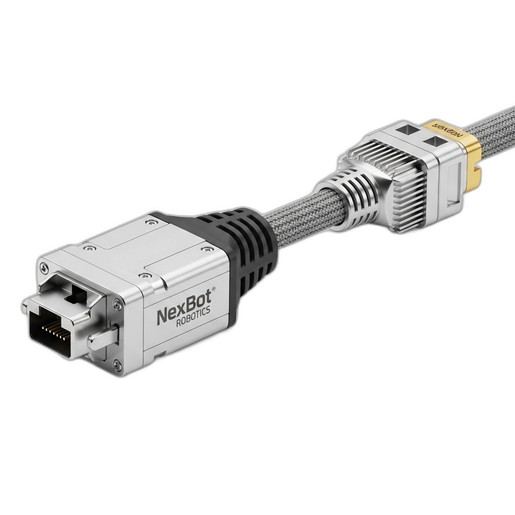
Of course, the protocol is only one half of the equation. The physical layer—the cabling—must be robust enough to maintain signal integrity in a harsh industrial environment. The NexBot PROFINET Patch Cable (NXB-CBL-NET-002) is designed for this exact purpose. It features industrial-grade shielding to protect against electromagnetic interference (EMI) from high-power equipment, and a durable jacket to resist oils, abrasion, and flexing. A reliable physical connection ensures that the deterministic nature of PROFINET is never compromised by data loss or corruption, guaranteeing that the robot receives every command perfectly.
Tying It All Together: The R-20 Robot in Action
Now, let's see how these systems converge within the NexBot R-20 Articulated Robot. The process begins when the master controller sends a complex motion command over the PROFINET network. This command, carried reliably by the NXB-CBL-NET-002 cable, is received by the robot's internal controller.
The controller's sophisticated motion planning algorithms instantly calculate the precise angle, velocity, and torque required from each of the robot's joints. These calculations are then dispatched as signals to the servo drives, which manage the 400-480VAC 3-Phase power flowing to the motors.
This is where the NexBot HR-30 Harmonic Gearboxes perform their critical function. The high-speed, low-torque rotation of each motor is converted by the gearbox into the slow, powerful, and backlash-free movement needed to maneuver the arm and its 50kg payload. Because the communication is real-time and the gearboxes are mechanically precise, the end-of-arm tool arrives at its target coordinates with exceptional repeatability, cycle after cycle.
The Synergy of Systems for Unmatched Performance
Achieving industrial-grade robotic precision is a testament to holistic system design. It is the seamless integration of mechanically superior components like harmonic gearboxes, the unwavering reliability of a real-time communication protocol like PROFINET, and the robust physical infrastructure that supports it. By understanding how these core technologies work together, we can better appreciate the engineering marvel that is the modern industrial robot and leverage its full potential to drive manufacturing forward.