The Shift from Isolated Arms to Coordinated Fleets
In the evolution of industrial automation, we've moved from programming single robotic arms for discrete tasks to orchestrating entire fleets of robots that work in concert. This leap in complexity and capability is powered by a sophisticated digital backbone: the fleet management system. No longer is it feasible to manage dozens of robots by walking the factory floor with a teach pendant. Today's dynamic production environments demand a centralized, networked approach to control, monitoring, and maintenance. This deep dive explores the technical architecture that makes this possible, revealing how software, networking, and hardware components interact to create a cohesive and efficient automated ecosystem.
At the heart of this evolution is the ability to see the entire production line as a single, data-driven entity. This holistic view enables manufacturers to optimize workflows, preempt downtime, and deploy new programs with unprecedented speed and reliability. The architecture behind this is a blend of robust networking, powerful software, and intelligent data analysis.
The Network Layer: TCP/IP as the Industrial Workhorse
The foundation of any fleet management system is the communication protocol. While various fieldbus protocols exist for real-time control at the machine level, the de facto standard for plant-level communication and fleet management is TCP/IP (Transmission Control Protocol/Internet Protocol). Its prevalence in IT infrastructure makes it a natural choice for bridging the gap between the factory floor (OT) and enterprise systems (IT).
Why TCP/IP? Its strengths are perfectly suited for this application:
- Reliability: TCP ensures that data packets are delivered correctly and in order. In a complex manufacturing process like robotic welding, a lost command to adjust amperage or wire speed could result in a defective part. TCP's handshake and error-checking mechanisms prevent this.
- Scalability: The protocol is designed to handle vast networks. A system built on TCP/IP can scale from a handful of robots to dozens or even hundreds without a fundamental architectural redesign. This is critical for growing operations.
- Flexibility: It can carry a wide variety of data types, from simple status updates and error codes to complex multi-megabyte robot programs and diagnostic logs.
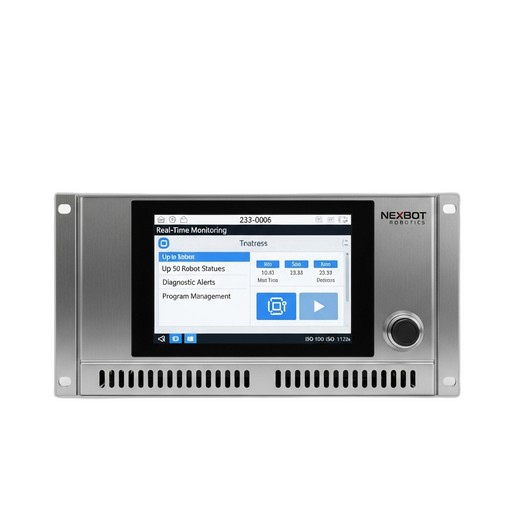
This network layer is the nervous system connecting every robot back to a central brain. A solution like the NexBot Drives 233-006 Fleet Management Software License leverages this robust TCP/IP backbone to establish stable, high-bandwidth communication with up to 50 robots simultaneously.
Core Architectural Components
A typical robotic fleet management system consists of three primary components working in unison:
- The Central Management Server: This is the core intelligence of the system. It runs the primary fleet management software, which houses the central database of robot programs, configuration files, user permissions, and historical performance data. It's the single source of truth for the entire robotic fleet.
- The Robot Agent/Interface: Each robot controller on the network runs a small software client or agent. This agent is responsible for communicating with the central server. It listens for commands (e.g., 'download new program,' 'report status'), executes them, and streams telemetry data back to the server. This data includes joint positions, motor torque, cycle times, and the status of any connected end-of-arm tooling (EOAT).
- The Human-Machine Interface (HMI): This is the user-facing dashboard, typically a web-based or desktop application, where engineers and technicians interact with the system. From this single pane of glass, users can view real-time dashboards of the entire fleet's status, drill down into the diagnostics of a single robot, manage program versions, and schedule maintenance tasks.
Data in Motion: From Central Command to the Welding Arc
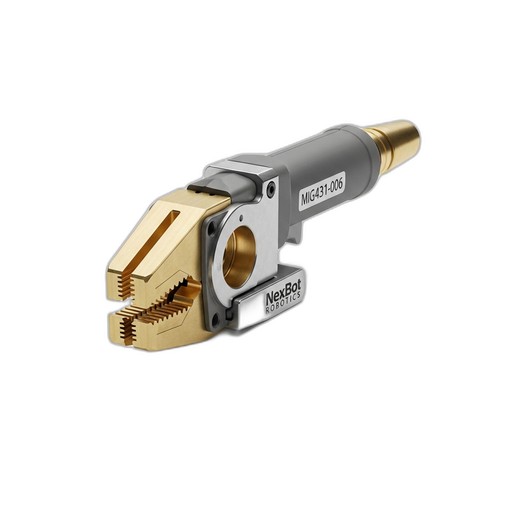
Let's trace the flow of data in a practical scenario: deploying a new welding program to a robot equipped with a NexBot Drives MIG431-006 Mig/Mag Welding Torch.
First, an engineer uploads the new welding path and parameter set to the central server via the HMI. The server then pushes this program over the TCP/IP network to the target robot's controller. The robot agent receives the program and loads it into memory.
When the production command is given, the robot controller begins executing the program. It translates pathing data into precise electrical signals for the arm's servo motors. Simultaneously, it sends commands to the welding torch. These aren't simple on/off signals; they are nuanced instructions controlling critical parameters like amperage, voltage, and wire feed speed, all synchronized with the robot's movement. For a high-performance torch rated for 400A, precise digital control is essential to achieve consistent, high-quality welds and avoid defects.
The beauty of this architecture is that the entire process is managed and logged centrally. The fleet management software knows which program version is running on which robot, ensuring process consistency and traceability.
The Feedback Loop: Enabling Predictive Maintenance
Communication is not a one-way street. As the robot operates, the agent continuously streams diagnostic data back to the central server. This feedback loop is the key to unlocking advanced capabilities like condition monitoring and predictive maintenance.
The server collects and analyzes data points such as:
- Motor current and temperature to detect signs of strain.
- Cycle completion times to spot developing inefficiencies.
- Vibration analysis from onboard sensors.
- Operational hours and cycle counts for key components.
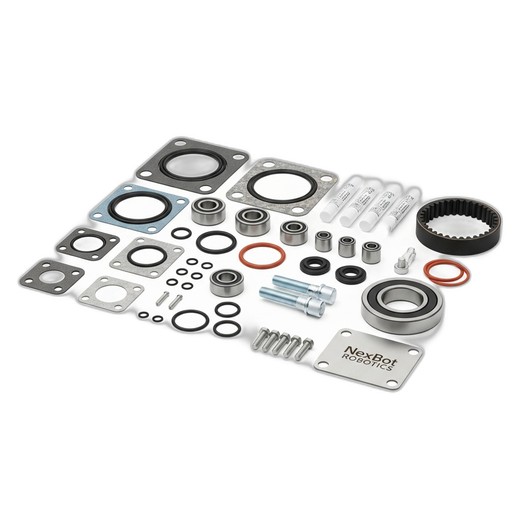
This is where physical maintenance and digital management intersect. The fleet management software can be configured with the known service intervals for wear parts. For example, it can track the operational hours of the robot's most stressed axes. When a predefined threshold is reached, the system can automatically generate a work order for a technician to perform scheduled service using the NexBot Robotics 713-004 O-Ring And Gasket Kit. This proactive approach prevents unexpected failures of critical components like the J2 and J3 axis seals, which are essential for maintaining the positional accuracy required for precision tasks. Replacing seals before they fail prevents lubricant contamination and costly unplanned downtime, turning maintenance from a reactive fire-fight into a predictable, scheduled activity.
By unifying control, monitoring, and maintenance under a single architectural umbrella, robotic fleet management systems provide the digital backbone necessary for building the smart, resilient, and highly productive factories of the future.