Introduction: Beyond the Traditional Assembly Line
For decades, the image of an industrial robot was one of a large, powerful arm, caged for safety, performing a single, repetitive task with brute force and precision. While that model still has its place, the landscape of industrial automation is undergoing a profound transformation. Driven by the principles of Industry 4.0, the demand for greater flexibility, and the rise of human-robot collaboration, the modern factory requires robots that are not just powerful, but also intelligent, adaptable, and aware of their environment. This evolution isn't just about the robots themselves; it's about the ecosystem of advanced components that gives them these new capabilities.
Trend 1: The Data-Driven World of Industry 4.0
The fourth industrial revolution, or Industry 4.0, is built on a foundation of data and connectivity. In a smart factory, machines, sensors, and systems communicate seamlessly, providing real-time insights that optimize production, enable predictive maintenance, and improve quality control. Industrial robots are central to this vision, acting as both data generators and data-driven actors.
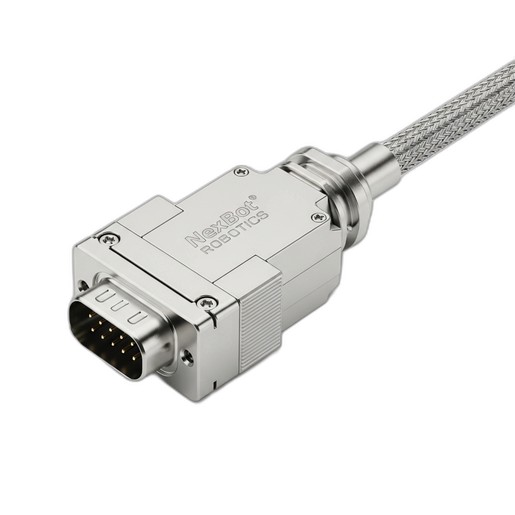
This shift places immense importance on the underlying infrastructure. Communication must be fast, reliable, and robust enough to withstand harsh industrial environments. High-speed protocols like EtherCAT and PROFINET are becoming standard, enabling the near-instantaneous data transfer required for complex motion control and sensor feedback. To maintain this crucial link, components like the NexBot Robotics 532-005 Rectangular Connector are essential. With a rugged, IP67-rated design, it ensures that the vital flow of power and data remains uninterrupted by dust, moisture, or vibration, providing the high-reliability connections that smart factories depend on.
Trend 2: The Rise of Collaborative Robotics
Perhaps the most visible trend is the growth of collaborative robots, or 'cobots.' Designed to work safely alongside human operators, cobots are unlocking new possibilities in assembly, inspection, and material handling. Unlike their traditional counterparts, cobots often perform tasks that require a degree of finesse and environmental awareness—a 'sense of touch.'
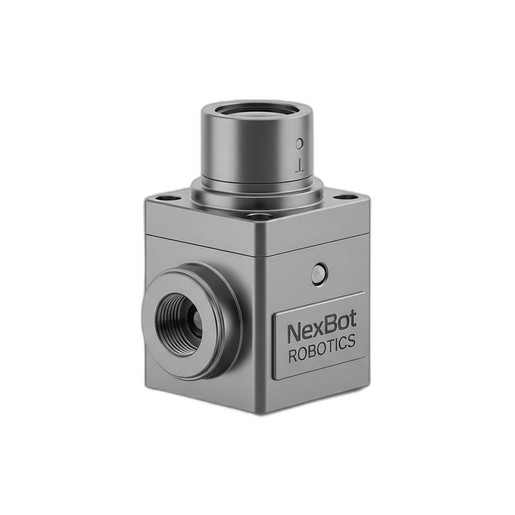
This is where advanced sensing technology becomes critical. A high-precision sensor like the NexBot Drives 311-006 6-Axis Force/Torque Sensor is a game-changer for collaborative applications. By providing the robot's controller with real-time feedback on all forces and torques being applied, it allows for sophisticated force-control applications. This enables a robot to perform delicate tasks like sanding a surface with consistent pressure, inserting a peg into a tight-fitting hole, or safely stopping if it encounters an unexpected obstacle (like a human arm). The data from these sensors is the key to making human-robot collaboration both safe and effective, bridging the gap between mechanical power and human dexterity.
Trend 3: Modularity and On-Demand Flexibility
Modern manufacturing is defined by smaller batch sizes, customized products, and rapidly changing consumer demands. The era of a production line set up for a single product for years is fading. Today's factories must be agile, capable of retooling and reconfiguring lines in hours, not weeks. This requires a modular approach to automation, where robots can be easily adapted for new tasks.
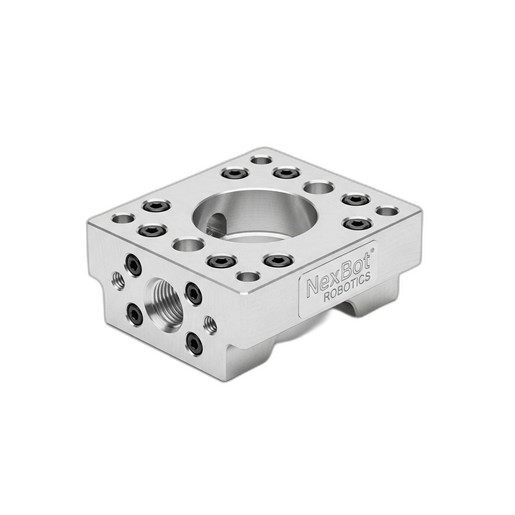
End-of-arm tooling (EOAT) is at the heart of this flexibility. A robot's ability to switch from a gripper to a welder to a polishing tool is what makes it a versatile asset. This process, however, must be fast, precise, and repeatable. Standardized mounting solutions are the key enablers of this modularity. The NexBot Robotics 813-005 Tool Adapter Plate, for example, is built on the ubiquitous ISO 9409-1 standard. This ensures compatibility with a wide range of tooling and robots, simplifying integration and drastically reducing changeover time. Precision-machined from high-grade aluminum, it provides a rigid, reliable connection, ensuring that tool center point (TCP) accuracy is maintained every time a new tool is attached. This simple but critical component empowers manufacturers to re-task their robotic assets with confidence and speed.
Conclusion: Building the Factory of the Future, Component by Component
The future of industrial robotics is intelligent, collaborative, and incredibly flexible. These macro-trends are not abstract concepts; they are tangible realities being built today on a foundation of high-performance components. The ability of a factory to leverage data, integrate cobots, and adapt to new production demands relies on the quality and capability of its sensors, connectors, and mounting hardware. As automation continues to advance, these unsung heroes of the robotic cell will play an increasingly vital role in defining the art of the possible.