Introduction: The Dawn of the Smart Factory
The landscape of modern manufacturing is undergoing a seismic shift. Driven by the principles of Industry 4.0, factories are transforming into highly interconnected, intelligent ecosystems. At the heart of this revolution is industrial robotics, which has evolved from repetitive, caged-off machinery into a dynamic and integral part of the production process. Today's automation trends are not just about replacing manual labor; they're about augmenting human capabilities, optimizing complex workflows, and unlocking unprecedented levels of efficiency and quality. This article explores the dominant trends shaping the future of industrial robotics and how they are paving the way for the smart factory of tomorrow.
Trend 1: The Rise of Collaborative Robotics
Perhaps the most significant trend in recent years is the proliferation of collaborative robots, or 'cobots.' Unlike traditional industrial robots that operate in isolated work cells, cobots are designed to work safely alongside human employees. Equipped with advanced sensors and safety-rated motion control, they can handle tedious, repetitive, or ergonomically challenging tasks, freeing up human workers to focus on higher-value activities that require critical thinking, dexterity, and problem-solving skills. This human-robot collaboration is boosting productivity and flexibility, particularly in small and medium-sized enterprises (SMEs) where production lines often need to be reconfigured for different products.
Trend 2: AI and Machine Vision Driving Intelligence
Artificial intelligence (AI) and machine learning (ML) are infusing industrial robots with a new level of intelligence. AI-powered vision systems enable robots to identify, inspect, and handle objects with greater precision and adaptability than ever before. This is critical for applications like quality control, where a robot can detect microscopic defects, or in bin-picking, where it can identify and grasp randomly oriented parts. Furthermore, ML algorithms allow robots to learn from experience, optimizing their own paths and movements for speed and energy efficiency, a process known as reinforcement learning. This self-improvement capability is a cornerstone of the self-optimizing smart factory.
Trend 3: Simplified Programming and Intuitive Control
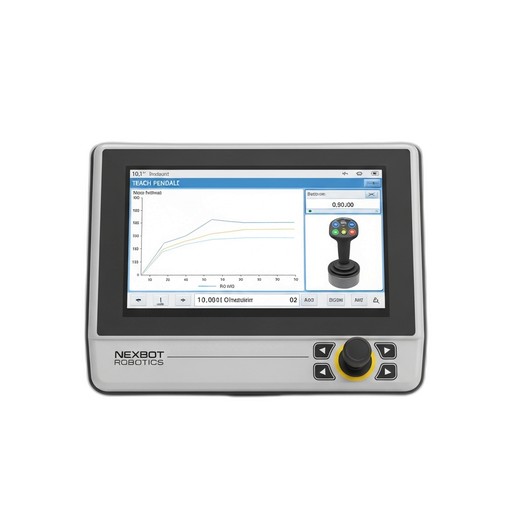
The days of requiring specialized programming expertise to operate a robot are numbered. The industry is moving towards more accessible and intuitive control interfaces that empower a wider range of employees to program and manage robotic systems. A key enabler of this trend is the modern teach pendant. Devices like the NexBot Robotics 221-005 Teach Pendant are replacing complex command-line interfaces with graphical, user-friendly touchscreens. With its responsive 10.1-inch display and ergonomic design, operators can use simple drag-and-drop functions, visual cues, and joystick control to define waypoints and program complex tasks. This democratization of robot programming significantly reduces training time, lowers the barrier to automation adoption, and allows for faster deployment and reconfiguration on the factory floor.
Trend 4: Sophisticated and Versatile End-of-Arm Tooling (EOAT)
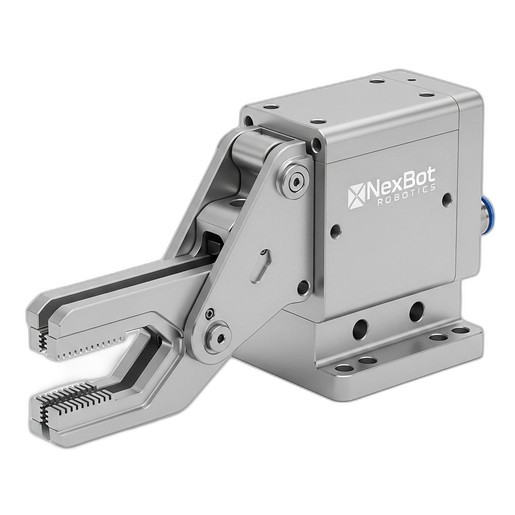
A robot is only as capable as the tool at the end of its arm. Consequently, the innovation in End-of-Arm Tooling (EOAT) is a critical trend. Grippers, sensors, and other tools are becoming more intelligent, versatile, and precise. For tasks requiring delicate and accurate manipulation, such as electronics assembly or medical device manufacturing, the performance of the gripper is paramount. The NexBot Robotics PNU411-005 Pneumatic Gripper, for example, exemplifies this trend by delivering not just a strong 120 N gripping force but also an exceptional repeatability of ±0.02 mm. This level of precision ensures that small parts are handled consistently and reliably, reducing errors and improving final product quality. The ability to quickly swap out different EOAT also adds to the flexibility of a robotic cell, allowing a single robot to perform multiple different tasks within a production cycle.
Trend 5: A Proactive Shift to Predictive Maintenance
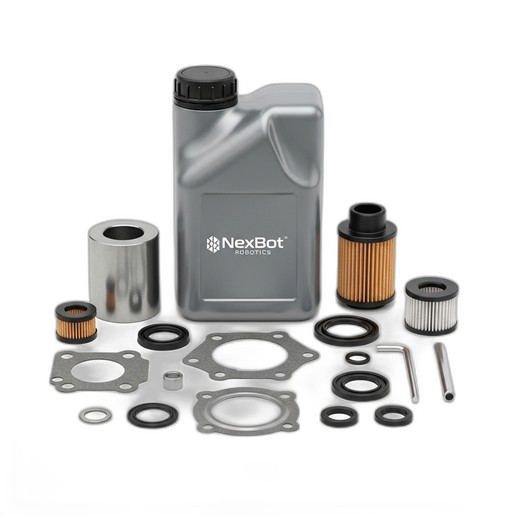
In a highly automated environment, downtime is the enemy. The focus is shifting from reactive repairs to proactive, predictive maintenance strategies. By embedding sensors throughout robotic systems and leveraging the Industrial Internet of Things (IIoT), manufacturers can collect real-time data on the health and performance of their equipment. This data can be analyzed to predict potential failures before they occur, allowing maintenance to be scheduled during planned downtime. This strategy extends beyond just major components. Even consumables play a vital role. Using high-performance lubricants like the NexBot Vision 732-003 Gearbox Oil (ISO VG 150) ensures that critical mechanical systems, like the robot's gearbox, operate smoothly and wear is minimized. By tracking operational hours and performance data, maintenance teams can replace fluids and wear parts based on actual need rather than a fixed schedule, optimizing resource use and maximizing the operational life of their robotic assets.
Conclusion: Navigating the Future with Intelligent Automation
The trends shaping industrial robotics—collaboration, AI integration, simplified control, advanced EOAT, and predictive maintenance—are not isolated developments. They are interconnected threads weaving together the fabric of Industry 4.0. By embracing these advancements, manufacturers can build more resilient, efficient, and flexible operations. At NexBot Robotics, we are committed to providing the components and systems that power this transformation, from intuitive teach pendants that empower your workforce to high-precision grippers and essential maintenance consumables that keep your operations running at peak performance.