Introduction: The Unsung Hero of Robotic Control
In the world of industrial robotics, the massive articulated arms and their fluid, powerful movements often steal the show. But behind every precise weld, every gentle grasp, and every flawless measurement lies a complex network of components working in perfect harmony. Among the most critical, yet often overlooked, of these are the Input/Output (I/O) modules. These devices are the central nervous system of an automated cell, translating sensory information from the physical world into a language the robot's controller can understand and act upon.
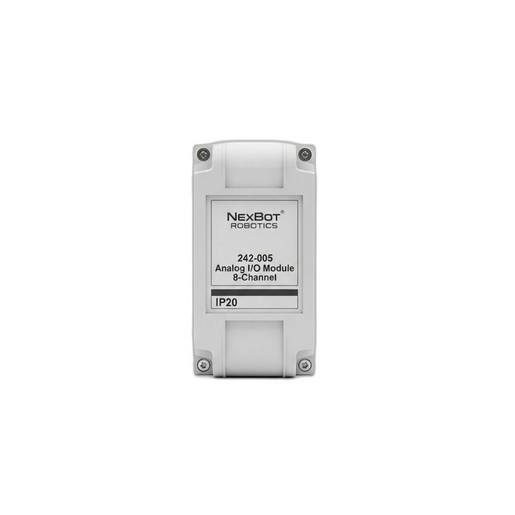
Today, we're putting a spotlight on a foundational component in this system: the NexBot Robotics 242-005 Analog I/O Module. This 8-channel module is engineered to provide the high-fidelity data translation necessary for applications demanding nuance and precision, forming the bridge between analog sensors and digital decision-making.
Precision in Translation: The NexBot Robotics 242-005 Module
At its core, an analog I/O module converts continuous, variable signals—like pressure, temperature, flow rate, or distance—into discrete digital values. Unlike binary on/off signals, analog signals represent a range of values, providing a much richer and more detailed picture of the operating environment. The quality of this conversion is paramount; any loss in translation can lead to errors, inefficiencies, and compromised product quality.
The NXB-GEN-242-005 is designed specifically for this challenge. Operating on a standard 24VDC industrial power supply, it offers eight dedicated channels for receiving analog inputs. This multi-channel capability allows a single module to manage data from a variety of sensors simultaneously, making it a versatile and space-efficient solution for complex robotic cells. Whether monitoring the pressure in a pneumatic gripper, the temperature of a welding tip, or the distance measured by a laser sensor, the 242-005 ensures that the robot controller receives a stable, accurate, and timely data stream to inform its every move.
Key Features and Technical Advantages
The effectiveness of a robotic system is directly tied to the quality of its sensory input. The NexBot Robotics 242-005 module is built with features that enhance data integrity and system reliability:
- High-Resolution Conversion: The module provides high-resolution analog-to-digital conversion, ensuring that even subtle changes in sensor readings are captured accurately. This is crucial for applications like force-torque sensing in assembly or precise dispensing operations where minute adjustments are key.
- Robust Industrial Design: Housed in a durable enclosure, the 242-005 is built to withstand the electrical noise, vibrations, and temperature fluctuations common on the factory floor. This rugged construction guarantees consistent performance and a long service life.
- Streamlined Integration: Designed for service-ready installation, the module features clear connection points and integrates seamlessly into existing control cabinets. This simplifies both initial setup and future maintenance, reducing downtime.
- Specification-Driven Planning: As with all NexBot components, the 242-005 is supported by comprehensive documentation, enabling engineers and maintenance teams to plan for replacements and system expansions with confidence.
Building a Complete Sensing Solution
An I/O module is only as good as the data it receives. The entire signal chain, from the sensor to the controller, must be optimized for accuracy. This starts with the physical mounting of the sensor itself. A sensor that is insecurely mounted or poorly positioned will produce noisy or inaccurate data, regardless of the quality of the I/O module.
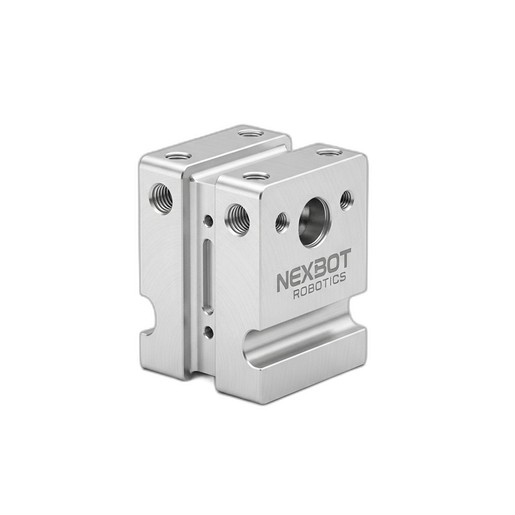
This is where the NexBot Robotics 812-005 Sensor Mounting Bracket (NXB-SNS-812-005) plays a vital supporting role. Engineered for rigidity and precise alignment, this bracket ensures that sensors are held firmly in their optimal position, free from vibration that could corrupt readings. By providing a stable physical foundation, the NXB-SNS-812-005 guarantees that the analog signal sent to the 242-005 I/O module is a true and clean representation of the physical environment. Furthermore, its compatibility with modern protocols like IO-Link signifies its place in a smart, interconnected factory ecosystem where component health and data are easily accessible.
Real-World Applications
The combination of a high-performance analog I/O module and properly installed sensors unlocks a wide range of advanced robotic capabilities:
- Automated Quality Control: A robot equipped with a laser displacement sensor can measure part tolerances with incredible precision. The sensor's analog output is fed through the NXB-GEN-242-005, allowing the robot to sort parts based on minute dimensional variations.
- Adaptive Material Handling: Using pressure sensors in a gripper, a robot can apply just the right amount of force to handle delicate or variably shaped objects. The 242-005 translates the continuous pressure readings, enabling the robot to adjust its grip in real-time.
- Process Monitoring & Control: In robotic welding or dispensing applications, the module can monitor analog signals for temperature, flow rate, and motor current. This data allows the system to maintain optimal process parameters, ensuring consistent quality and reducing defects.
Ensuring Uptime and Performance: The Role of Maintenance
Deploying best-in-class hardware is the first step. The second, equally important step is ensuring it performs reliably for its entire lifecycle. The sophisticated electrical systems that underpin modern robotics require a high level of technical skill to maintain and troubleshoot.
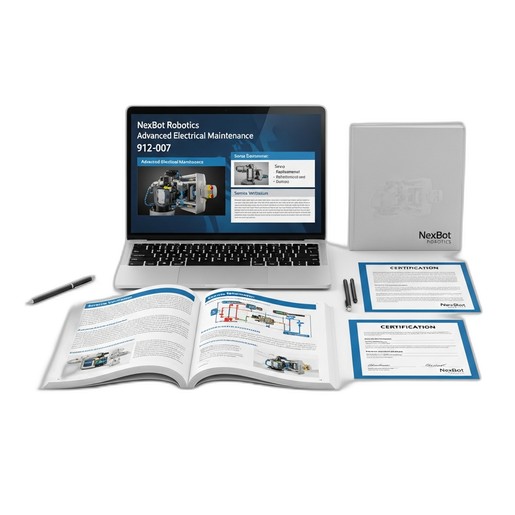
This is why comprehensive training is not a luxury, but a necessity. The NexBot Robotics Training Course 912-007 Advanced Electrical Maintenance (NXB-KIT-912-007) is designed to empower technicians with the expertise needed to manage systems built around components like the 242-005 I/O module. This intensive, hands-on course covers everything from reading schematics and diagnosing signal integrity issues to safely replacing and configuring modules. By investing in skilled personnel, companies can dramatically reduce downtime, improve first-time fix rates, and maximize the return on their automation investment.
Conclusion: The Foundation of Smart Automation
The NexBot Robotics 242-005 Analog I/O Module is more than just a component; it's a critical enabler of intelligent automation. By providing a reliable and precise link between the analog world of sensors and the digital realm of robotic control, it allows machines to perceive, adapt, and execute tasks with greater sophistication than ever before. When supported by robust mechanical components like the 812-005 Sensor Mounting Bracket and a well-trained maintenance team, it forms the nerve center of a truly responsive and productive automated system.