Introduction: Beyond the Steel and Servos
When we envision an industrial robot, we often picture powerful arms, intricate grippers, and the precise, tireless motion of servo motors. While this hardware is the muscle of modern manufacturing, its true power is unlocked by an invisible force: the constant stream of data that flows through its digital nervous system. This nervous system is built upon industrial communication protocols, the specialized languages that allow controllers, robots, sensors, and actuators to communicate with the speed and reliability required for complex automation tasks.
Understanding these protocols is crucial for anyone involved in designing, integrating, or maintaining robotic systems. The choice of protocol and the quality of the underlying physical infrastructure directly impact a system's performance, from its cycle time and positioning accuracy to its functional safety. In this deep dive, we'll explore the fundamentals of these protocols, focusing on the industrial Ethernet standards that dominate the factory floor today.
What is an Industrial Communication Protocol?
At its core, an industrial communication protocol is a set of rules and conventions governing the transmission of data between devices in an automated system. Unlike standard office Ethernet, which prioritizes bandwidth and data integrity for tasks like file transfers and web browsing, industrial protocols are engineered for one primary characteristic: determinism.
Determinism is the guarantee that a message will be sent and received within a precise, predictable time window. In a multi-axis robotic application, where motion must be perfectly synchronized, a delay of even a few milliseconds can lead to positioning errors, collisions, or flawed products. Industrial protocols ensure that time-critical data, like a motor position command or a sensor trigger, arrives exactly when it's needed, every single time. Key characteristics include:
- Real-Time Capability: Data is exchanged within strict, microsecond-level time constraints.
- Robustness: Protocols and the associated hardware are designed to withstand the electrical noise (EMI), vibrations, and temperature fluctuations common in industrial environments.
- Scalability: They can support a wide range of network sizes, from a single machine cell to an entire factory floor.
The Rise of Industrial Ethernet: EtherCAT and PROFINET
The automation industry has largely transitioned from older, slower serial fieldbuses to protocols based on the familiar Ethernet standard. This shift has unlocked massive increases in speed, bandwidth, and connectivity. Two of the most prominent industrial Ethernet protocols are EtherCAT and PROFINET.
EtherCAT: Speed Through Simplicity
EtherCAT (Ethernet for Control Automation Technology) is renowned for its exceptional performance and unique operating principle. Instead of the traditional method where each device (node) receives a packet, processes it, and then sends it to the next node, EtherCAT processes data 'on the fly.'
An EtherCAT master sends a single Ethernet frame that travels through all the slave devices on the network. As the frame passes through each node, the device reads the data addressed to it and inserts its own data into the frame in real-time. The frame continues to the last node, then loops back to the master. This process is incredibly efficient, resulting in ultra-low latency and highly synchronized communication, making it ideal for applications requiring fast, precise motion control.
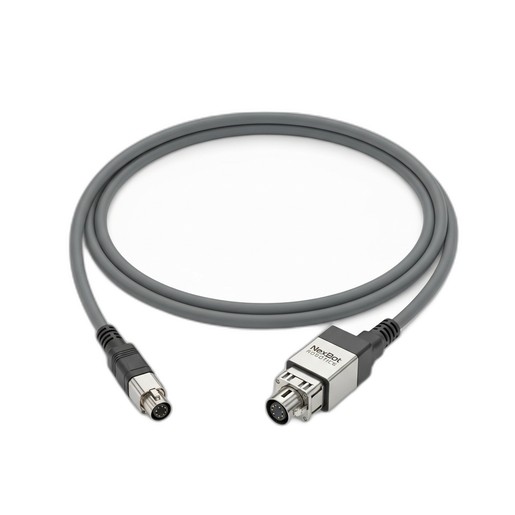
This high-speed data transmission demands a physical layer that can keep up. A standard office cable is insufficient. For dynamic robotic applications where cables are constantly in motion, a high-flexibility cable like the NexBot Drives NET522-006 Fieldbus Cable is essential. Its robust PUR (polyurethane) jacket resists oils and abrasion, while its double-shielding construction protects the EtherCAT signal from electromagnetic interference, ensuring data integrity and preserving the protocol's performance advantages.
PROFINET: Flexible and Scalable
PROFINET (Process Field Network) is another leading industrial Ethernet standard, known for its scalability and tight integration with a wide range of automation controllers. It offers different communication classes to suit various application needs:
- PROFINET RT (Real-Time): Used for standard automation tasks with cycle times in the millisecond range.
- PROFINET IRT (Isochronous Real-Time): Provides a higher level of determinism with microsecond-level synchronization, making it suitable for high-performance motion control.
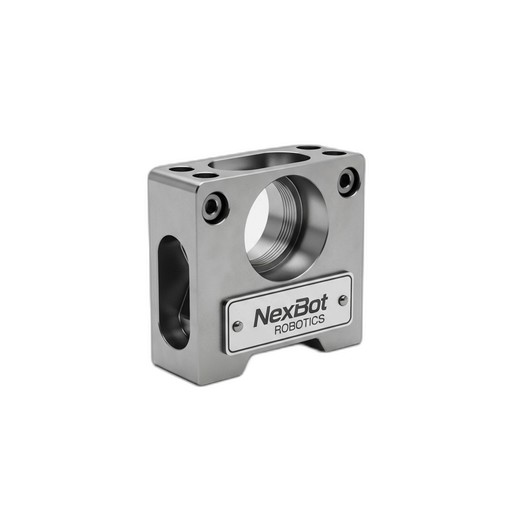
PROFINET's flexibility allows it to serve as a comprehensive backbone for factory automation, connecting everything from I/O blocks and sensors to entire robotic cells. The components within these cells are designed for seamless integration into the network architecture. For example, a component like the NexBot Drives AC811-006 Servo Mounting Bracket is more than just a piece of metal; it's an engineered part designed to precisely position a servo motor within a larger PROFINET-controlled system. Its design ensures the mechanical stability needed to translate the protocol's digital commands into accurate physical motion, capable of handling the forces generated by servos in its class.
Integrating Safety Over the Network
Historically, safety circuits were always hardwired separately from the control network. While effective, this approach resulted in complex wiring, difficult diagnostics, and limited flexibility. Modern protocols have evolved to include functional safety extensions, such as PROFIsafe (for PROFINET) and FSoE (FailSafe over EtherCAT).
These safety protocols allow safety-related data to travel over the same cable as standard control data. This is achieved by 'tunneling' safety information within the standard communication frame, using special error detection mechanisms and time-stamping to ensure its integrity. This simplifies wiring, reduces component count, and provides rich diagnostic data, allowing operators to pinpoint the exact cause of a safety event.
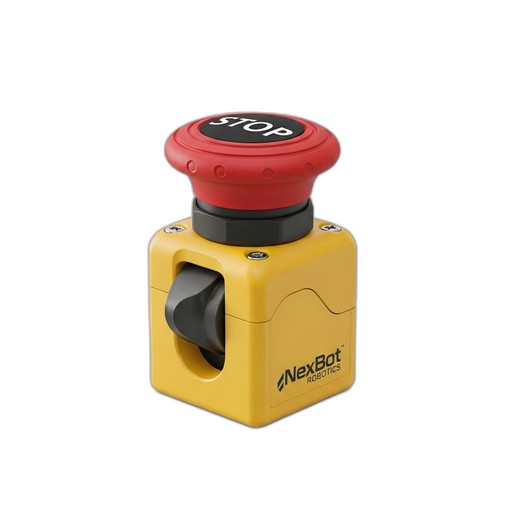
Even in a network-based safety system, critical components like emergency stops remain vital. The NexBot Safety 622-008 Twist-Release Emergency Stop Device provides the immediate, reliable machine shutdown signal required by safety standards. While its primary function is to physically break a circuit, its status is monitored by a safety PLC. When the E-stop is activated, the PLC receives this critical input and uses the high-speed safety protocol to command a coordinated, safe stop across the entire robotic system, demonstrating the perfect synergy between hardwired safety principles and networked control.
Conclusion: The Backbone of Modern Automation
Industrial communication protocols are the unsung heroes of the smart factory. They form the high-speed, deterministic backbone that enables the incredible precision, speed, and safety of modern robotic systems. Whether it's the on-the-fly efficiency of EtherCAT or the scalable flexibility of PROFINET, these digital languages are what turn mechanical hardware into intelligent, productive automation. By supporting these advanced protocols with robust physical components—from high-flex, shielded cables to precisely engineered mounting hardware and reliable safety devices—we build systems that are not only powerful but also resilient and safe, ready for the challenges of Industry 4.0.