Introduction: The Unseen Language of Motion
In any advanced industrial robotics system, the mechanical components—the arms, grippers, and joints—are only half the story. The other half is an intricate, high-speed conversation happening every millisecond. This is the world of industrial communication protocols, the digital nervous system that connects the robot's 'brain' (the controller) to its 'muscles' (the motors and drives). Just as a human nervous system coordinates complex movements, these protocols ensure that every axis moves with perfect timing and precision. Understanding the differences between these protocols is crucial for designing, integrating, and maintaining efficient and reliable automation systems.
Why Standard Ethernet Isn't Enough: The Demand for Determinism
One might ask, "Why can't we just use the same Ethernet that runs our office networks?" The answer lies in a single, critical concept: determinism. In an office environment, if an email takes a few extra milliseconds to arrive, the consequences are negligible. In a robotic work cell, a delay of a few milliseconds can lead to positioning errors, faulty products, or even dangerous collisions.
Industrial protocols are designed for deterministic communication, which guarantees that data packets arrive within a predictable, fixed time window. This is achieved by managing network access and data transmission in a highly structured way, eliminating the variable delays (known as jitter) common in standard IT networks. This unwavering predictability is the foundation upon which high-performance motion control is built.
EtherCAT: The Master of Synchronized Motion
When an application demands extremely fast, tightly synchronized multi-axis motion, EtherCAT (Ethernet for Control Automation Technology) is often the protocol of choice. Its unique operating principle sets it apart from many other industrial Ethernet variants.
Instead of the traditional model where the master controller sends a separate message to each slave device (like a servo drive), EtherCAT employs an ingenious 'on-the-fly' processing method. A single Ethernet frame leaves the master, travels through every node in the network segment, and returns. As the frame passes through each device, that device reads the data designated for it and inserts its own data into the frame as it continues downstream. This process is executed in hardware and is incredibly fast, allowing for cycle times in the microsecond range.
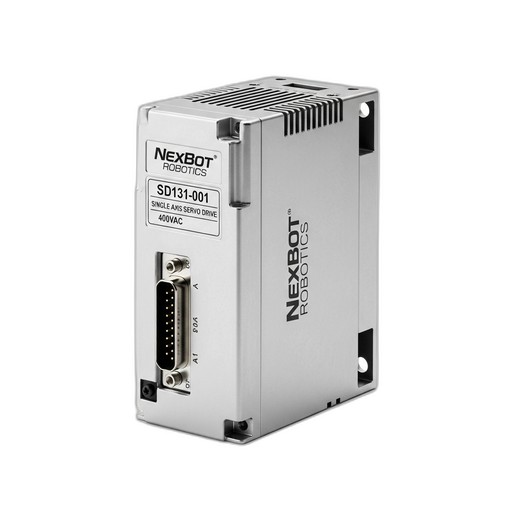
This is precisely why a component like the NexBot Robotics SD131-001 Single-Axis Servo Drive utilizes EtherCAT. For a servo drive tasked with executing precise motion profiles—accelerating, holding a position, and decelerating with sub-millimeter accuracy—the low latency and high synchronization of EtherCAT are non-negotiable. In a multi-axis gantry or a complex articulated robot arm, EtherCAT ensures that all servo drives execute their commands in perfect unison, as if they were a single, cohesive unit.
EtherNet/IP and PROFINET: The Versatile System Integrators
While EtherCAT excels at the device-level motion bus, other protocols are masters of higher-level system integration. This is where protocols like EtherNet/IP and PROFINET shine. They are commonly used to connect entire robotic systems, PLCs, HMIs, and vision systems into a single, cohesive production cell.
These protocols operate on a producer-consumer (EtherNet/IP) or provider-consumer (PROFINET) model. Devices publish data to the network, and any other authorized device can subscribe to that data. This model is exceptionally flexible and is ideal for coordinating the actions of different pieces of equipment from various manufacturers.
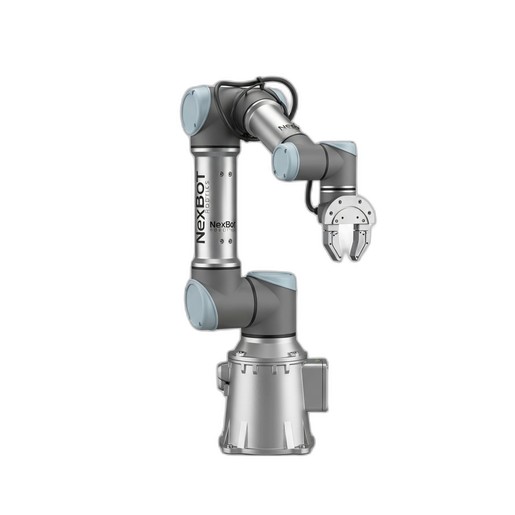
The NexBot Robotics FLR022-001 Collaborative Robot Arm, for instance, supports EtherNet/IP, PROFINET, and Modbus TCP. This versatility allows it to be integrated seamlessly into a wide range of existing factory automation architectures. The cobot might receive a high-level command from a central PLC via PROFINET—such as "move to pick-up position"—while its internal joint motors are coordinated by a dedicated, high-speed motion control bus. This hierarchical communication structure leverages the strengths of different protocols for different tasks: system-level coordination and high-speed, deterministic motion control.
The Physical Foundation: Where Protocol Meets Reality
The most sophisticated communication protocol is useless without a robust physical layer. This includes not only high-quality industrial-grade cabling and connectors but also the fundamental mechanical integrity of the robot itself. The precision commanded by a servo drive over EtherCAT can only be realized if the mechanical assembly is rigid and accurately aligned.
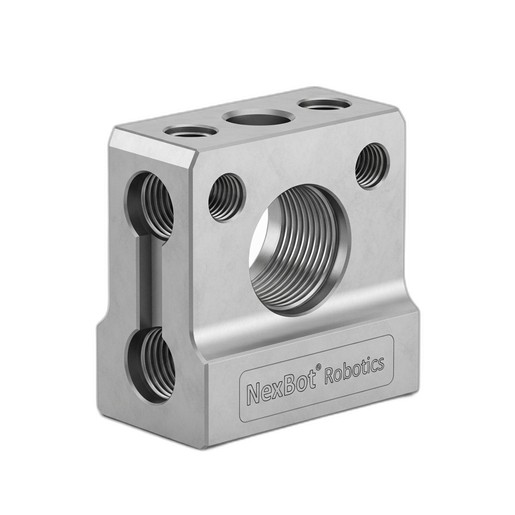
This is where fundamental components like the NexBot Drives 832-002 Dowel Pin And Key Set play their unsung role. These high-tolerance fasteners ensure that motor shafts are perfectly coupled to gearboxes and that mounting flanges are precisely located. Without this mechanical precision, the system would suffer from backlash and compliance, rendering the microsecond-level accuracy of the control system meaningless. The protocol provides the command, but the hardware delivers the result.
Conclusion: Choosing the Right Language for the Job
There is no single 'best' industrial protocol; there is only the best protocol for a specific application. The choice is a critical engineering decision that balances the need for speed, synchronization, interoperability, and system topology.
- For high-performance, multi-axis motion control requiring microsecond-level synchronization, a protocol like EtherCAT, as implemented in the NexBot SD131-001 servo drive, is the superior choice.
- For flexible, cell-level integration connecting robots, PLCs, and other supervisory systems, the widespread support and versatility of EtherNet/IP and PROFINET, found on the NexBot FLR022-001 cobot, are ideal.
By understanding the fundamental principles and distinct advantages of these digital nervous systems, engineers and technicians can build more capable, efficient, and reliable robotic automation solutions for the challenges of Industry 4.0.