The Evolution of Robotic Perception
For decades, industrial robots have been the workhorses of manufacturing, executing repetitive tasks with superhuman speed and endurance. Traditionally, these machines operated 'blindly,' following pre-programmed paths with immense precision but with little to no awareness of their immediate environment. Any unexpected variation—a slightly misplaced part or an unforeseen obstacle—could lead to errors, damage, or production halts. Today, we are in the midst of a paradigm shift, moving from simple positional automation to adaptive, intelligent robotics. The key to this evolution is giving robots a sense of touch.
This isn't science fiction; it's the reality of modern automation, made possible by sophisticated components working in perfect harmony. At the heart of this capability lies the 6-axis force/torque (F/T) sensor, a device that provides rich, multi-dimensional feedback, allowing a robot to feel its way through a task. In this deep dive, we'll explore the technology that enables this robotic 'sense of touch,' focusing on the interplay between the sensor, the robot arm, and the critical communication infrastructure that ties them together.
The Anatomy of a Feeling Robot
To understand how a robot can 'feel,' we must look at the core components that form its perception and action system. A typical advanced robotic cell consists of three key elements:
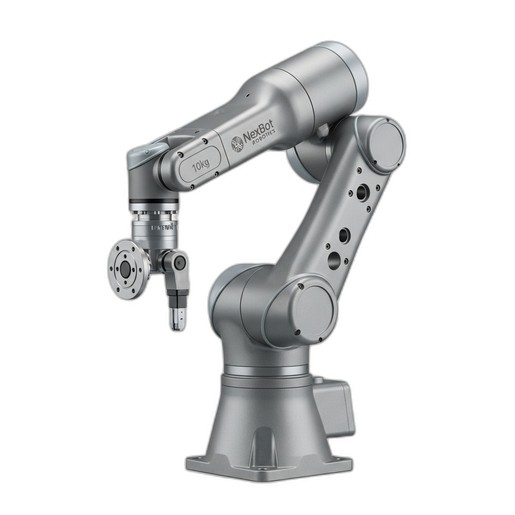
- The Actuator: The robot arm itself, responsible for motion. A versatile arm like the NexBot Safety SA011-008 provides the physical platform. With its 6 axes of movement, 10kg payload, and 1300mm reach, it has the dexterity and strength required for complex tasks like assembly, polishing, or machine tending.
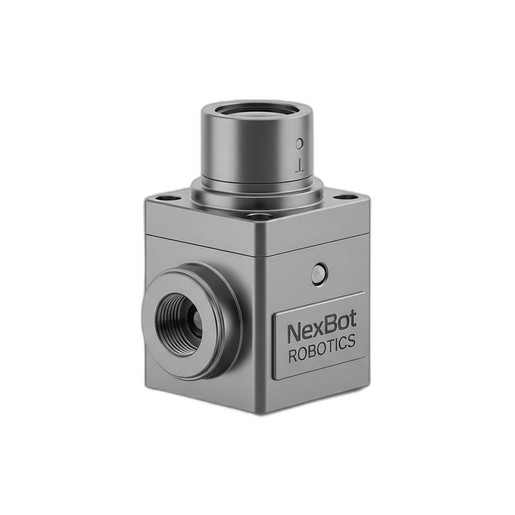
- The Sensor: The 'nerve endings' of the system. A high-precision sensor like the NexBot Drives 311-006 6-Axis Force/Torque Sensor is mounted, typically between the robot's wrist and the end-of-arm-tooling (EOAT). This component is the star of our story, translating physical interactions into usable data.
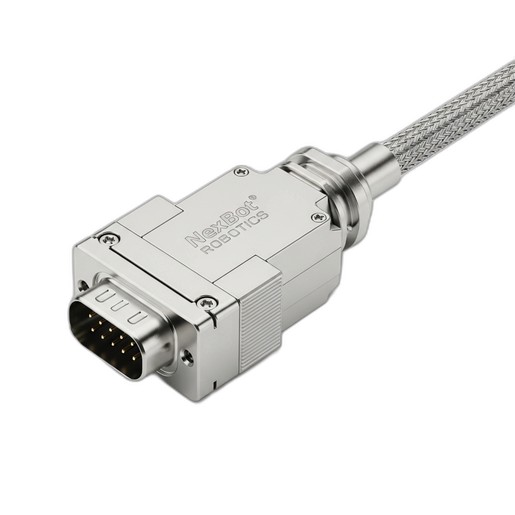
- The Communication Backbone: The nervous system that transmits signals between the sensor and the robot controller. This includes high-speed protocols and the physical hardware, such as rugged industrial connectors like the NexBot Robotics 532-005, which ensure data integrity even in harsh factory environments.
Together, these components create a closed-loop system where the robot doesn't just execute a command but intelligently adapts its motion based on real-time physical feedback.
Decoding the Data: How 6-Axis F/T Sensors Work
A 6-axis force/torque sensor measures forces and torques along all three spatial axes (X, Y, and Z). This means it can simultaneously detect pushes, pulls, and twists in any direction. The NexBot Drives 311-006, for example, provides a constant stream of high-resolution data that tells the robot controller exactly what the end-effector is experiencing.
This data unlocks a range of advanced capabilities:
- Complex Assembly: For tasks like 'peg-in-hole' insertions where tolerances are tight, the robot can use F/T feedback to feel for alignment and gently guide a part into place, preventing jamming and damage. It can detect the subtle forces indicating a successful insertion.
- Surface Finishing: In applications like sanding, deburring, or polishing, the sensor allows the robot to maintain a constant pressure against a contoured surface. As the tool moves, the robot dynamically adjusts its path to compensate for surface variations, ensuring a consistent, high-quality finish.
- Safe Collaboration: In collaborative applications, F/T sensors are a cornerstone of safety. They can detect unexpected contact with an object or a person, allowing the robot to stop immediately, far faster than vision systems in some scenarios.
This level of control is only possible if the data is delivered instantly and reliably. This is where the communication protocol becomes critical.
The Need for Speed: Real-Time Communication with EtherCAT
Imagine trying to catch a ball with a one-second delay between what your eyes see and what your hands do. It would be impossible. The same principle applies to sensor-driven robotics. The data from the F/T sensor must be processed by the robot controller in real-time to allow for instantaneous adjustments to the robot's motion.
This is why industrial Ethernet protocols like EtherCAT are essential. Both the NexBot SA011-008 robot arm and the NXB-SNS-311-006 sensor utilize the EtherCAT protocol. Unlike standard Ethernet, EtherCAT is deterministic, meaning data packets arrive at predictable, consistent intervals with extremely low latency (microseconds). It processes data 'on the fly' as the frame passes through each device, rather than being received and re-transmitted at each node. This architecture is perfectly suited for the high-frequency data streams generated by an F/T sensor, ensuring the robot's motion control loop has the most current information to act upon.
The Unsung Hero: Robust Connectivity
A high-speed communication protocol is only as reliable as its physical connection. In a demanding industrial environment filled with vibrations, dust, moisture, and temperature fluctuations, a standard connector would quickly fail, leading to data loss and system failure. This is why ruggedized components are non-negotiable.
The NexBot Robotics 532-005 Rectangular Connector is an example of the kind of robust hardware required. Its IP67 rating signifies that it is completely dust-tight and can withstand temporary immersion in water. This level of protection is crucial for components located near the robot's 'wrist,' which may be exposed to coolants, lubricants, or wash-down procedures. While high-performance connectors are designed for various protocols like PROFINET or EtherCAT, the core principle remains the same: a secure, environmentally sealed physical link is the foundation upon which reliable data communication is built. Without it, the sophisticated dialogue between sensor and robot would be silenced.
Conclusion: A Synergy of Technologies
The ability for a robot to 'feel' is not the result of a single breakthrough but a synergy of advanced technologies. It requires a mechanically precise and agile robot arm, a highly sensitive multi-axis sensor to capture nuanced physical data, a deterministic, low-latency communication protocol to transmit that data instantly, and rugged physical connectors to guarantee signal integrity.
By integrating components like the NexBot SA011-008 robot, the NXB-SNS-311-006 sensor, and industrial-grade connectivity solutions, manufacturers can move beyond simple pick-and-place operations. They can automate delicate, complex tasks that were once only possible with human dexterity, unlocking new frontiers in efficiency, quality, and operational flexibility.