The Need for Speed and Precision in Automation
In the world of industrial robotics, every microsecond counts. The ability of a robot arm to move with perfect accuracy, for its various axes to operate in flawless synchronization, and for sensors to provide real-time feedback is not a luxury—it's a fundamental requirement. This level of performance hinges on the communication protocol that acts as the system's central nervous system. While standard Ethernet is excellent for office networks, it lacks the determinism required for high-performance motion control. This is where specialized industrial protocols come in, and one of the most powerful is EtherCAT (Ethernet for Control Automation Technology).
What is EtherCAT?
EtherCAT is a real-time Industrial Ethernet protocol originally developed to bring Ethernet's speed and accessibility to the factory floor without its non-deterministic drawbacks. It operates on a master/slave principle, but its true genius lies in how it processes data. Unlike traditional protocols where each node (or slave device) receives a data packet, processes it, and then forwards it, EtherCAT uses a unique 'processing-on-the-fly' approach.
An EtherCAT master sends a single Ethernet frame that travels down the line, passing through each slave node. As the frame passes through a node's hardware, the node reads the data addressed to it and inserts its own data into the frame in real-time. The entire process introduces only nanoseconds of delay per node. The frame continues to the last node, reverses direction, and returns to the master, which then receives a single frame containing the updated data from all nodes. This method is incredibly efficient, allowing for extremely short cycle times and a massive increase in bandwidth utilization.
Determinism and Synchronization: The Heart of Motion Control
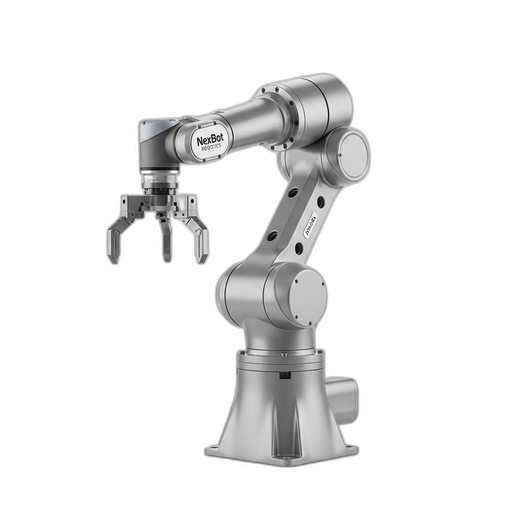
For a multi-axis robot like the NexBot Robotics FLR022-007 Collaborative Robot Arm, precision is everything. Each joint, powered by a sophisticated motor and drive system, must execute its commands at the exact same moment to produce a smooth, accurate tool path. This is only possible with a deterministic network—one where data packets are guaranteed to arrive within a predictable, fixed time window.
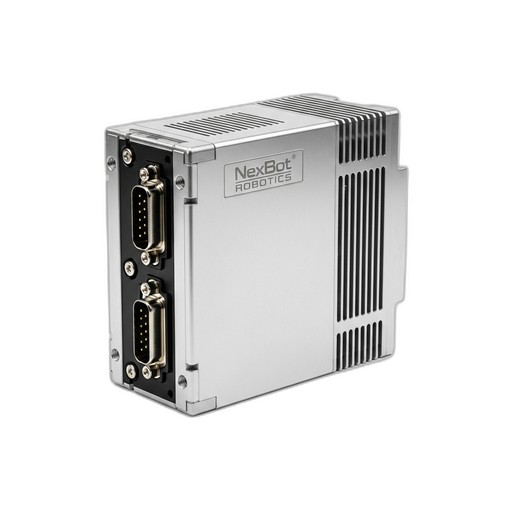
EtherCAT achieves exceptional determinism through its Distributed Clocks (DC) mechanism. This feature synchronizes the internal clocks of all slave devices on the network with sub-microsecond accuracy. When the master controller, like the one commanding the NexBot Robotics SD131-005 Servo Drive, issues a command, it can be timestamped to execute simultaneously across all synchronized nodes. The result is perfectly coordinated motion, free from the jitter and timing inconsistencies that can plague less advanced systems. This synchronization is critical for applications requiring high precision, such as welding, dispensing, or complex pick-and-place operations.
The NexBot Advantage: EtherCAT in Action
At NexBot Robotics, we leverage the power of EtherCAT to deliver the performance our customers demand. The protocol is integral to our ecosystem, ensuring seamless communication between controllers, robots, and peripheral components.
- NexBot Robotics FLR022-007 Cobot: The 1300 mm reach and 10 kg payload of this cobot are managed with exceptional fluidity and precision thanks to EtherCAT. The high-speed data exchange allows the controller to process complex kinematic calculations and adjust the position of each joint in real-time, enabling safe and reliable human-robot collaboration.
- NexBot Robotics SD131-005 Servo Drive: This high-performance servo drive relies on EtherCAT's low latency to receive setpoints and transmit feedback (like position and torque) almost instantaneously. This tight control loop is essential for achieving the dynamic response and accuracy needed in demanding robotic applications.
Beyond Performance: Simplicity and Robustness
While speed and determinism are EtherCAT's primary benefits, it also offers practical advantages for system integrators and maintenance teams. It uses standard Ethernet cabling, which is cost-effective and readily available. The protocol supports a highly flexible network topology—line, tree, star, or any combination—without requiring complex switches or hubs, simplifying wiring and reducing potential points of failure.
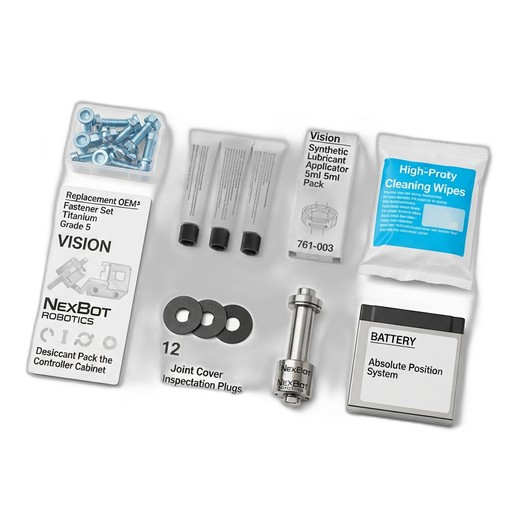
Furthermore, EtherCAT includes robust diagnostic capabilities. The master can detect the exact location of a cable break or faulty node, significantly reducing troubleshooting time. This reliability is crucial for maintaining uptime on the factory floor. To ensure these high-performance systems continue to operate at their peak, a proactive maintenance strategy is essential. Using OEM-certified kits like the NexBot Vision 761-003 Multi-Part Maintenance Kit ensures that all components, from fasteners to lubricants, meet the original specifications required for such a precisely tuned system.
Conclusion: The Backbone of Industry 4.0
The move towards smarter, more connected factories (Industry 4.0) requires a communication backbone that is both fast and incredibly reliable. EtherCAT provides this foundation, enabling the real-time data flow necessary for advanced robotics, machine vision, and synchronized multi-axis control. By integrating this powerful protocol into products like our FLR022-007 cobot and SD131-005 servo drive, NexBot Robotics is building the responsive, precise, and intelligent automation solutions that will define the future of manufacturing.