The Digital Backbone of the Smart Factory
In any advanced manufacturing environment, communication is everything. The ability for robots, controllers, sensors, and other devices to exchange data rapidly and reliably is what separates a disjointed collection of machines from a truly integrated, intelligent automation system. While standard office Ethernet is excellent for sending emails, it's not designed for the deterministic, high-speed demands of industrial motion control. This is where Industrial Ethernet protocols come in, and one of the most powerful and widely adopted standards is PROFINET.
PROFINET (Process Field Network) is more than just a ruggedized Ethernet cable; it's a complete communication standard that enables the seamless flow of data from the enterprise level right down to the factory floor. It provides the speed and determinism required to orchestrate complex robotic movements with microsecond precision, making it the digital nerve center for demanding applications.
What Makes PROFINET Ideal for Robotics?
PROFINET leverages standard Ethernet technology but enhances it with specific protocols to guarantee performance. This combination delivers several key advantages that are critical for modern robotic systems.
Real-Time Performance
Perhaps the most crucial feature of PROFINET is its real-time capability. This is broken down into different performance levels:
- RT (Real-Time): This class handles the vast majority of automation tasks, with cycle times in the millisecond range. It's suitable for standard I/O, diagnostics, and parameterization.
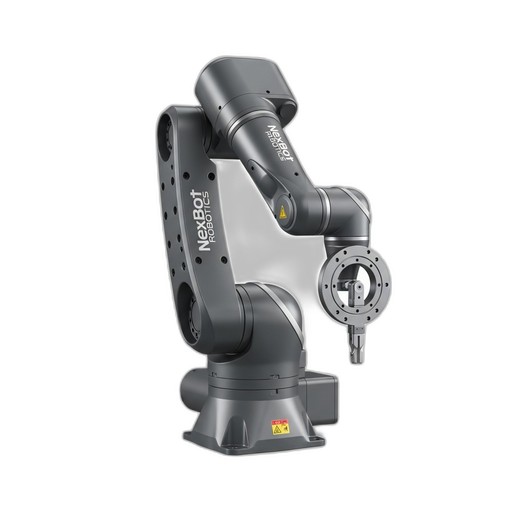
- IRT (Isochronous Real-Time): This is the game-changer for high-performance motion control. IRT uses a time-slicing mechanism to create a deterministic schedule on the network, guaranteeing data packets arrive at a precise, predictable moment. For a multi-axis robot like the NexBot Robotics 822-005 6-Axis Robot Arm, this is essential. It ensures that the commands for all six axes are perfectly synchronized, enabling smooth, accurate, and highly repeatable tool path movements, even at high speeds with heavy payloads.
Bandwidth and Data Versatility
PROFINET operates at high speeds (100 Mbit/s and higher), providing ample bandwidth for all types of factory communication. This means a single network can simultaneously handle time-critical motion control data for a robot, process data from sensors, diagnostic information for maintenance teams, and even video feeds from vision systems without compromising the performance of any single task. This convergence simplifies network architecture and reduces cabling costs.
Flexibility and Integration
As an open standard, PROFINET supports a wide range of network topologies—including line, star, and ring—giving system designers immense flexibility. It allows for the easy integration of devices from various manufacturers, fostering an open automation ecosystem. This means a NexBot robot can communicate seamlessly with a central PLC, third-party sensors, and safety controllers, all on the same network.
PROFINET in Action: Precision Under Pressure
The capabilities of a high-performance robot are unlocked by its communication protocol. Consider the NexBot Robotics 822-005, a powerful 6-axis arm designed for production-grade tasks with its 120 kg payload capacity and 2,500 mm reach. Whether it's performing intricate welding, precisely placing heavy components, or rapidly palletizing finished goods, its ability to execute these tasks depends entirely on the quality of the data it receives. PROFINET IRT ensures that the complex motion profiles calculated by the controller are translated into perfectly synchronized motor commands, cycle after cycle, million after million. This deterministic communication is what guarantees the robot's path accuracy and repeatability, which are critical for product quality and throughput.
From Commissioning to Long-Term Reliability
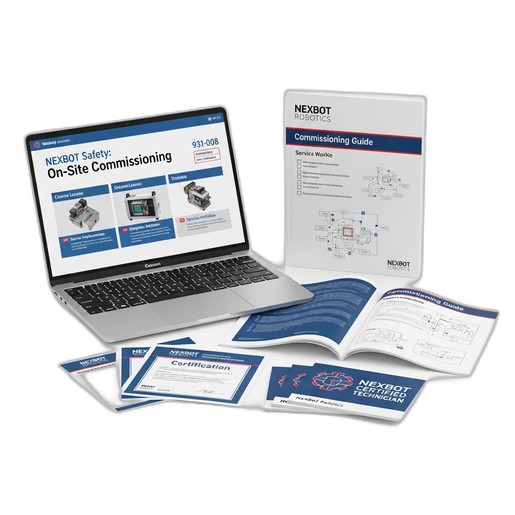
A powerful system requires expert implementation. Setting up a PROFINET network for a mission-critical robotic cell goes beyond connecting cables. It involves careful network design, device configuration, and rigorous testing to ensure real-time performance is achieved and maintained. This is why our NexBot Safety 931-008 On-Site Commissioning Service is so valuable. Our certified technicians ensure that your entire system, from the robot controller to the network infrastructure, is optimized for peak performance and safety from day one.
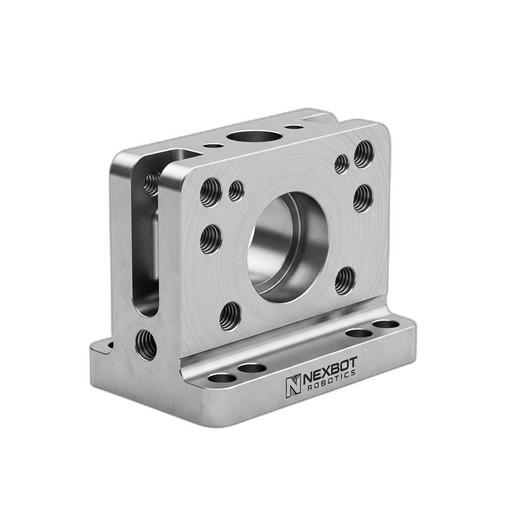
However, digital precision must be matched by mechanical integrity. Over time, the immense forces generated by a large industrial robot can lead to microscopic shifts in mechanical alignment if not properly maintained. The digital commands sent over PROFINET assume the robot is a perfect mechanical system. To preserve this integrity, scheduled maintenance is key. Using high-quality, hardened steel components like those found in the NexBot Robotics 832-005 Dowel Pin And Key Set during service intervals ensures that joints and mounting points remain perfectly aligned. This synergy between a robust digital protocol and meticulous mechanical maintenance is the foundation of long-term robotic reliability and performance.
Conclusion
PROFINET is a cornerstone technology for Industry 4.0, providing the high-speed, deterministic communication necessary to power the next generation of industrial automation. It transforms a robotic arm from a standalone machine into a fully integrated, high-performance component of a larger smart factory ecosystem. By combining the advanced digital control enabled by PROFINET with robust hardware and expert commissioning, manufacturers can unlock new levels of productivity, precision, and operational intelligence.